

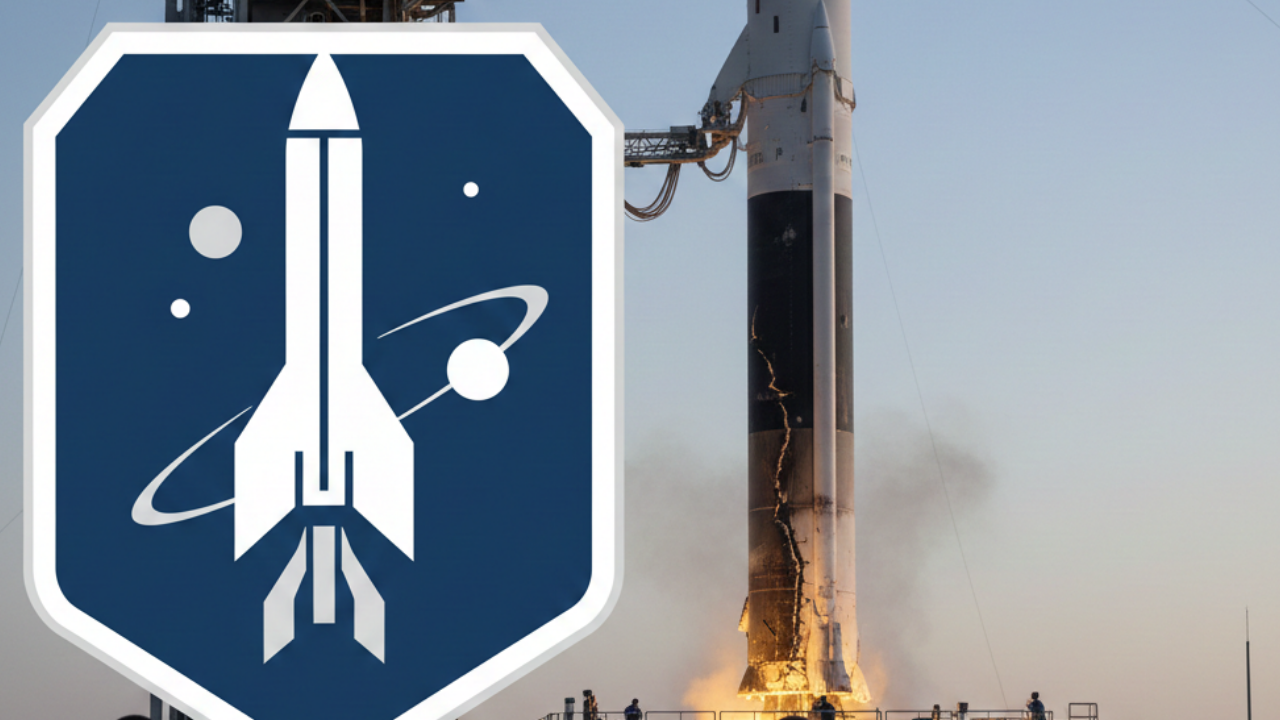
The U.S. Space Force has paused future Vulcan rocket launches after a solid rocket booster anomaly on a recent national security mission, putting a temporary hold on one of the Pentagon’s newest heavy‑lift launch vehicles. United Launch Alliance (ULA) and its booster supplier Northrop Grumman are now leading a formal investigation to determine the root cause before any Vulcan missions resume.
Space Force orders pause after latest Vulcan anomaly
The decision follows a February 12 Vulcan Centaur launch from Cape Canaveral that successfully delivered multiple classified U.S. Space Force payloads to geosynchronous orbit but suffered a “significant performance anomaly” in one of its four strap‑on solid rocket boosters during ascent. Observers noted burn‑through and fragmentation near the nozzle of a booster, yet the main Vulcan booster and Centaur upper stage continued to perform normally, allowing the mission to reach its planned orbit.
Col. Eric Zarybnisky, the Space Force’s portfolio acquisition executive for assured access to space, said the service will not fly additional National Security Space Launch (NSSL) missions on Vulcan until the anomaly is fully understood and corrected. “Mission success is the number‑one priority,” he told reporters at the Air and Space Forces Association’s Warfare Symposium, stressing that any anomaly triggers intensive engagement with contractors to identify and fix the problem before the next flight.
Investigation focuses on solid rocket booster
ULA confirmed that the anomaly originated in one of the Vulcan’s solid rocket boosters built by Northrop Grumman, which provide extra thrust at liftoff alongside Vulcan’s pair of BE‑4 main engines. It was the second booster‑related issue seen on Vulcan in four flights, with a previous nozzle problem reported on an earlier mission in a different booster configuration.
The company has established a joint investigation team, bringing in experts across industry to review telemetry, high‑speed imagery and physical hardware from the spent booster to pinpoint the defect. ULA vice president Gary Wentz said the investigation will be “thorough,” promising to identify root cause and implement all necessary corrective actions before Vulcan flies again. For readers seeking more technical background on Vulcan’s design and booster configuration, NASA’s launch systems pages offer useful context on modern heavy‑lift rockets:
Potential impact on GPS and commercial missions
The pause directly affects upcoming NSSL missions, including a high‑priority launch for the 10th GPS III satellite that had been slated for Vulcan this spring. The Space Force has already shifted several GPS III missions from Vulcan to SpaceX’s Falcon 9 amid earlier certification and schedule delays, and officials are now weighing whether further manifest changes are needed to maintain coverage and resiliency in the GPS constellation.
ULA had planned a substantial ramp‑up of Vulcan flights in 2026, targeting more than a dozen launches, including national security payloads and commercial missions such as broadband satellites for Amazon’s Project Kuiper. Any extended stand‑down to redesign or requalify the booster could ripple across that schedule, tightening capacity in a market where only ULA and SpaceX currently fly rockets certified for the Defense Department’s most sensitive missions. For ongoing coverage of U.S. launch schedules and manifest changes, readers can follow SpaceNews’ launch industry section
Safety and reliability remain top priority
Despite the alarming visuals of a booster nozzle burn‑through, both ULA and the Space Force emphasize that the Feb. 12 mission met all orbital objectives and demonstrated robust performance margins in Vulcan’s core systems. However, the recurrence of a booster‑related anomaly in Vulcan’s early flight history underscores how cautious the military remains as it transitions from legacy Atlas V and Delta IV vehicles to next‑generation launchers built entirely with U.S. hardware.
Space Systems Command says its launch enterprise team will work closely with ULA through its mission‑assurance and space‑flightworthiness process before clearing Vulcan for another national security mission. Until the joint investigation delivers answers and fixes, the message from the Space Force is clear: Vulcan will not carry additional national security payloads, even if that means rebalancing launches across other providers to protect critical space capabilities. For a broader overview of how the Pentagon manages launch risk and certification, the U.S. Government Accountability Office provides detailed reports








Leave a comment