

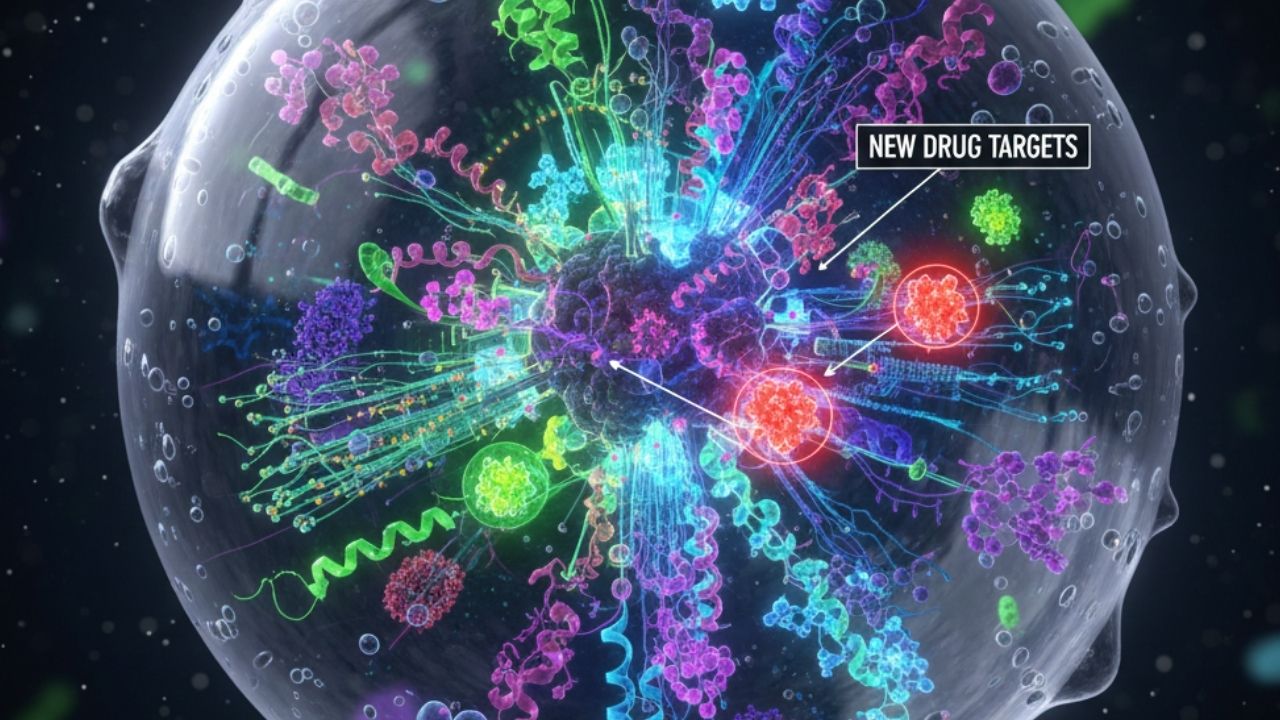
Scripps Research scientists have uncovered a hidden internal structure inside cell “droplets,” revealing an entirely new class of drug targets with major implications for cancer and neurodegenerative diseases. This breakthrough overturns a long‑held belief that these droplets, known as biomolecular condensates, were simple, shapeless liquids inside cells.
What Scripps Research Discovered
Biomolecular condensates are tiny droplet‑like compartments that help cells control vital processes like gene expression, protein quality control, and waste removal without using traditional membranes. For years, researchers assumed these condensates were structureless, which made them hard to target with drugs because there was nothing solid for a molecule to “grab” onto. The new Scripps Research study, published in Nature Structural & Molecular Biology, shows that some condensates are actually built from intricate networks of thread‑like protein filaments that create a defined internal architecture.
Led by associate professor Keren Lasker, the team used advanced cryo‑electron tomography (cryo‑ET), a technique similar to a CT scan at the molecular level, to visualize these condensates in unprecedented detail. They focused on a bacterial protein called PopZ, which forms condensates at the poles of rod‑shaped bacteria and helps organize proteins needed for cell division. Instead of a uniform droplet, they found a filamentous scaffold that assembles step by step to give the condensate its physical properties and structure.
Why the Hidden Structure Matters
To test whether this filament network was truly essential, the researchers engineered mutations that disrupted filament formation inside PopZ condensates. When the filaments were lost, the droplets became overly fluid, losing their proper surface tension and mechanical stability. In living bacteria, this change proved disastrous: cell growth stopped and DNA segregation failed, showing that condensate structure—not just its molecular ingredients—is critical for cellular function and survival.
This work fundamentally changes how scientists think about condensates in human health and disease. Condensate dysfunction has already been linked to cancer and neurodegenerative conditions such as ALS and other protein‑misfolding disorders. Knowing that some of these droplets contain a defined internal scaffold means researchers can now treat them as structured targets, similar to classical proteins, rather than as formless liquids.
New Drug Targets for Cancer and Brain Diseases
The discovery opens a promising new frontier in drug discovery: instead of only targeting individual proteins, future drugs could be designed to bind to, stabilize, or disrupt the filamentous scaffolds inside condensates. By tuning the physical properties of these droplets—such as how rigid or fluid they are—therapies might restore healthy cell function or halt disease processes in cancers and neurodegenerative disorders. This dramatically expands the “druggable” landscape inside cells and supports a new precision‑medicine strategy centered on condensate architecture.
For example, if a particular condensate helps suppress tumor growth, drugs could be designed to reinforce its filament network and preserve its function in cancer cells. Conversely, if a condensate contributes to toxic protein aggregation in the brain, scientists might develop small molecules that weaken or remodel its scaffold to prevent damage. External resources such as reviews on biomolecular condensates and phase separation in disease offer additional context for how these structures are shaping next‑generation therapeutics (see overviews in journals like Cell and Nature Reviews Molecular Cell Biology for broader background on condensate biology).
Advanced Tools and Future Directions
The Scripps Research team combined multiple cutting‑edge methods, including cryo‑ET, single‑molecule spectroscopy, and computational modeling, to map how condensates form and behave at high resolution. This multi‑disciplinary approach allowed them to link microscopic structure with real‑time biophysical properties and live‑cell behavior. Their findings suggest that protein conformation can depend on its location within a condensate, adding an extra layer of regulation that future drugs could exploit.
As more labs adopt these structural and imaging technologies, scientists expect to discover similar hidden architectures in other condensates involved in human disease. That could lead to a wave of new drug candidates aimed at condensate scaffolds, complementing existing efforts to target enzymes, receptors, and other well‑known proteins. Readers who want to explore related advances in targeting hard‑to‑drug proteins and expanding the “drug target universe” can find accessible explainers from leading research institutes and peer‑reviewed news platforms that track developments in structural biology and drug discovery.
In short, by revealing that cellular droplets have an internal filamentous skeleton, Scripps Research has identified a hidden layer of cellular organization—and with it, a powerful new set of drug targets for some of the most challenging diseases of our time.









Leave a comment