

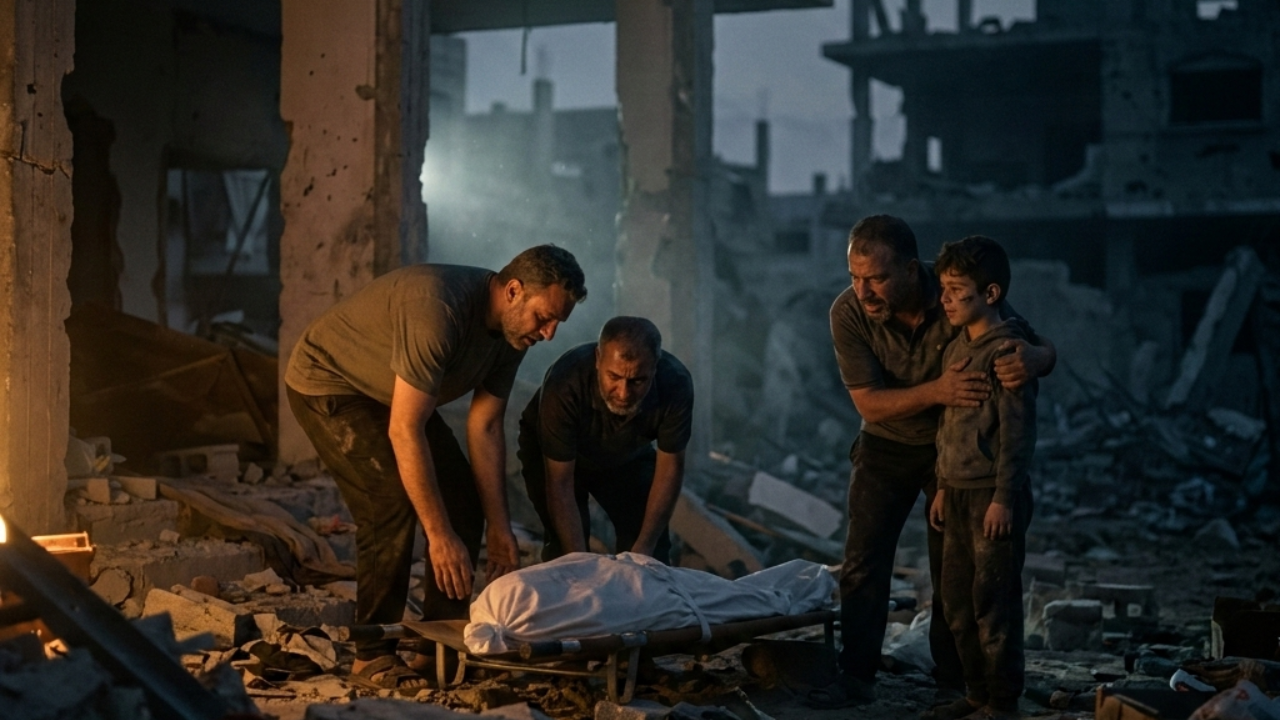
The attacks, reported on Friday in areas outside direct Israeli military control, underscore the precarious state of the US-mediated truce that began in October 2025, now strained by ongoing skirmishes and distrust between Israel and Hamas.
Strike Details Emerge
Gaza’s civil defense agency detailed a drone strike near Khan Yunis in the south shortly after midnight, killing three people, followed by an airstrike on a tent for displaced families west of the city that afternoon, claiming one more life. In northern Beit Lahia, Israeli gunfire killed two individuals, including Ahmed Saad Ghabn, 36, who succumbed to abdominal wounds at Al-Shifa Hospital, while a separate central Gaza incident added another fatality. Medical sources confirmed all targets lay beyond zones under Israeli deployment per the ceasefire terms, highlighting how violence persists in supposedly de-escalated regions.
The Israeli military justified the operations as retaliation for Hamas fighters emerging from a Rafah tunnel—a clear “ceasefire violation”—prompting air force strikes to neutralize the threat and additional actions “throughout the Strip.” This follows a pattern where Gaza’s health ministry, under Hamas control, reports 618 Palestinian deaths and 1,663 injuries from daily violations since the truce’s start, while Israel notes five soldier losses in the same period.
Ceasefire Background and Violations
The October 2025 ceasefire ended a brutal 15-month war that devastated Gaza, killing over 72,000 Palestinians—mostly women and children—and wounding 171,000, while obliterating 90% of civilian infrastructure. Hailed initially as a breakthrough, the deal entered its second phase last month, yet exchanges of blame have mounted: Hamas accuses Israel of blocking aid and demolishing homes in the north, while Israel points to militant incursions.
Friday’s toll adds to a grim tally, with Gaza’s Interior Ministry reporting a police officer killed at a Bureij refugee camp checkpoint on Salah al-Din Street, and others—including Eyad al-Attal, 37—dying in a school tent strike near Nasser Hospital. For more on the truce’s origins, see RFI’s coverage of initial violations.
Humanitarian Fallout Intensifies
These strikes exacerbate Gaza’s humanitarian crisis, where 2.3 million residents remain displaced amid ruins and restricted aid flows. Health officials decry routine airstrikes hitting residential zones, schools, and tents, mirroring earlier 2025 escalations that killed dozens in single days despite negotiation pushes. Families in Khan Yunis and Beit Lahia now face renewed trauma, with rescuers struggling under Hamas governance to retrieve bodies from rubble.
Israel maintains it targets only militants, as in Jabalia school strikes, while employing measures to limit civilian harm—yet Gaza medics report multi-story homes and refugee camps bearing the brunt. The pattern risks broader escalation, especially as external mediators urge restraint.
Key Impacts at a Glance
- Casualties: 7 killed (3 drone strike, 1 tent airstrike, 2 gunfire, 1 police checkpoint); multiple wounded.
- Locations: Khan Yunis (south), Beit Lahia (north), Bureij (central)—all non-Israeli zones.
- Ceasefire Toll: 618 Palestinian deaths since October 2025.
Regional and Global Reactions
Hamas and Palestinian factions condemned the strikes as “genocidal” extensions of the prior war, demanding international intervention, while Israel’s statement framed them as defensive necessities. Qatar-hosted talks, once promising, now appear stalled, echoing January 2025 pushes amid Rafah tunnel recoveries. For deeper analysis on mediation efforts, check Anadolu Agency’s report.
World leaders, including those in the US under President Donald Trump, face pressure to revive diplomacy as February 2026 violence spikes. Gaza’s fragile calm hangs by a thread, with civilians paying the highest price.
Path Forward Uncertain
As accusations fly, the ceasefire’s second phase teeters, with no immediate de-escalation signals. Gaza residents brace for more unrest, while the international community watches a conflict that has reshaped the Middle East. Urgent aid corridors and verified compliance mechanisms could salvage the truce—but history suggests challenges ahead.





Leave a comment