

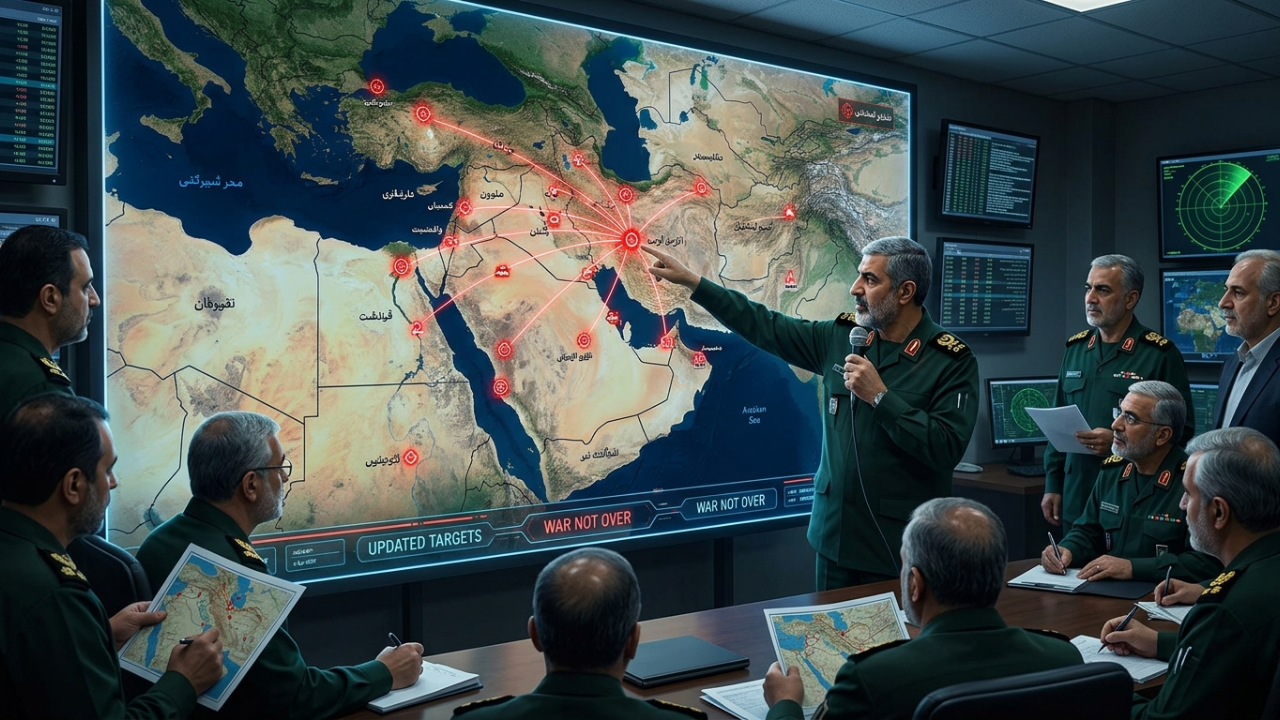
Iran has warned that its war with the United States and Israel is “not over,” as its military reveals that it is actively updating a broad target list that now goes beyond traditional military sites. The message signals that any ceasefire remains fragile and that Tehran is preparing for the possibility of renewed confrontation across multiple domains.
Iran says the war is “not over”
In a recent televised interview, Iranian Army spokesperson Brigadier General Mohammad Akrami Nia stated that Tehran does not consider the conflict with the US and Israel to have ended, despite ongoing ceasefire arrangements. He stressed that there is “no trust in America and our enemies,” underscoring Iran’s belief that hostilities could resume at any time.
Akrami Nia revealed that Iran has been “constantly” working to refine and expand its strategic objectives during the pause in fighting. He said the army and other branches have continued to “update our entire target bank,” indicating that Tehran’s military planning is very much active.
Iranian officials have also accused Washington of using economic and naval pressure to force concessions, as US President Donald Trump claims Iran is nearing “collapse” under sanctions and a naval blockade. Tehran has responded by charging transit fees in strategic waterways and denouncing the seizure of its vessels as “piracy” at the United Nations, further fueling tensions.
Updated target list: from bases to “capital and interests”
Iran’s updated target list goes well beyond classic battlefield objectives. According to Iranian media, Tehran has expanded its list of potential targets to include American “capital and interests,” marking a shift toward economic and infrastructure pressure points. Officials say this broader approach is a response to what they call direct threats against the Iranian people and critical civilian infrastructure.
Earlier reports from Iranian and regional outlets indicated that the military has prepared a list of sites across the Middle East that could be hit if US or Israeli forces strike Iran’s energy facilities again. In a reciprocity-based strategy, power plants in Israel and key infrastructure in US-allied states are said to be on this list, particularly those tied to the Western military presence. Iranian sources also suggested that Tehran could move to close or disrupt vital shipping lanes such as the Bab el‑Mandeb Strait and the Strait of Hormuz if Washington maintains or escalates its naval blockade.
At the same time, Iran’s Islamic Revolutionary Guard Corps (IRGC) has publicly designated a group of major US-linked corporations as “legitimate military targets,” warning employees to evacuate facilities linked to sensitive digital and industrial networks. Companies named in that list include global technology giants, aerospace manufacturers and financial institutions, signaling that Tehran views the digital economy and high‑tech infrastructure as part of the battlefield. Analysts note that this type of targeting aims to raise the cost of conflict for Washington and its allies by threatening assets far beyond the traditional front line.
For broader background on Iran’s evolving military and economic strategy, outlets such as the Institute for the Study of War and Critical Threats provide detailed timelines and assessments of recent developments.
Ceasefire under strain and risk of escalation
Iran’s insistence that the war is not over comes after a devastating US‑Israeli air campaign earlier this year that targeted political, military and energy sites inside the country. The strikes killed more than 1,200 people, including Supreme Leader Ali Khamenei, and wounded over 10,000 others, according to Iranian authorities. Subsequent Iranian missile and drone attacks hit targets in Israel, Iraq, Jordan and Gulf states hosting US forces, turning the conflict into a wider regional confrontation.
Although a ceasefire has reduced active large‑scale strikes for now, both sides appear to be preparing for the possibility of renewed clashes. Iranian officials say coordination between the regular army and the IRGC has deepened during the war, resulting in a more unified military posture as they continue to work on their “target bank.” US officials, meanwhile, maintain that sanctions are severely damaging Iran’s economy and insist that military options remain on the table if Tehran escalates again.
Regional observers warn that the combination of updated target lists, ongoing economic pressure and unresolved political disputes means the situation remains highly volatile. Any miscalculation—whether at sea, in the cyber domain or via proxy forces—could quickly trigger a new cycle of attacks that drags the region back into open war.






Leave a comment