

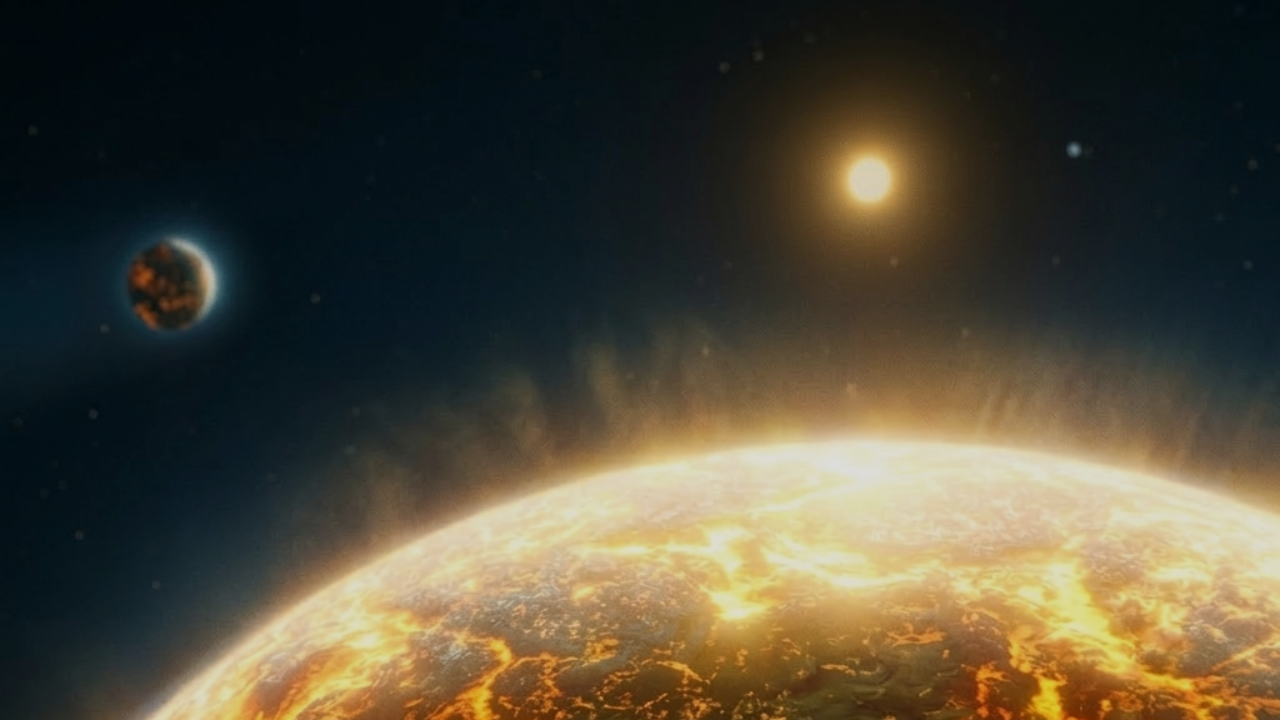
Astronomers at the University of Oxford have discovered a groundbreaking new category of exoplanet: molten worlds that hoard vast quantities of sulfur in perpetual magma oceans. This revelation, centered on the exoplanet L 98-59 d, challenges existing planetary classifications and expands our view of cosmic diversity.
Discovery of L 98-59 d: A Sulfur-Laden Inferno
L 98-59 d orbits a cool red dwarf star just 35 light-years from Earth, making it a prime target for observation. Recent data from the James Webb Space Telescope (JWST) in 2024 and ground-based telescopes revealed puzzling traits: the planet is roughly 1.6 times Earth’s size but unusually low in density, with its atmosphere laced with hydrogen sulfide—the infamous “rotten egg” gas.
Traditional models slotted such bodies into rocky gas dwarfs or icy ocean worlds, but L 98-59 d defies both. Instead, advanced simulations tracing nearly five billion years of evolution show its mantle hosts a global magma ocean of molten silicate, thousands of kilometers deep, acting as a sulfur storage vault. This setup buffers sulfur gases in the hydrogen-rich atmosphere, preventing their escape despite intense stellar radiation.
For full study details, read the original publication in Nature Astronomy: Volatile-rich evolution of molten super-Earth L 98-59 d.
How Simulations Unraveled the Planet’s Fiery Past
Researchers from Oxford, the University of Groningen, University of Leeds, and ETH Zurich built intricate computer models linking surface observations to deep interiors. These reconstructions reveal L 98-59 d likely started as a volatile-packed mini-Neptune, shrinking over eons as it cooled and shed atmosphere while retaining its molten core.
Ultraviolet rays from its host star, L 98-59, spark reactions producing sulfur dioxide and other gases aloft, while the magma ocean below cycles volatiles in and out. Surface temperatures could hit 1,900°C, with tidal forces from sibling planets whipping up waves in the lava sea—imagine a planet-sized cauldron of molasses-like magma.
Lead author Dr. Harrison Nicholls notes this upends simplistic exoplanet categories, hinting at untold varieties awaiting discovery. Professor Raymond Pierrehumbert emphasizes the thrill: models let us peer into unvisitable worlds’ histories, revealing solar system aliens.
Broader Implications for Exoplanet Diversity and Formation
This sulfur-centric class could be common among super-Earths near red dwarfs, planets more abundant than giants like Jupiter. Magma oceans mirror early Earth and Mars stages, offering clues to our rocky origins—how volatiles shaped habitable zones.
Future missions like ESA’s Ariel (launching 2029) and PLATO will flood us with data; the team plans machine learning to classify more such worlds. While L 98-59 d’s hellish heat rules out life, it sets benchmarks for spotting truly habitable rocks.
Dr. Richard Chatterjee from Leeds highlights hydrogen sulfide’s key role, joking “pungent planets” might proliferate—pending more JWST stares.
Why This Matters for Astronomy and Beyond
- Rewrites exoplanet taxonomy, urging broader volatile-inclusive models.
- Boosts understanding of rocky planet infancy, linking to Earth’s magma era.
Explore visuals and artist concepts at the University of Oxford Physics Department announcement. Or dive into Phys.org coverage: A new class of molten planet.
This Oxford-led breakthrough, published March 16, 2026, in Nature Astronomy, ignites excitement for the galaxy’s hidden menageries—proving our cosmic neighborhood was just the appetizer. As telescopes sharpen, expect more molten marvels to surface, reshaping hunts for life among the stars.









Leave a comment