

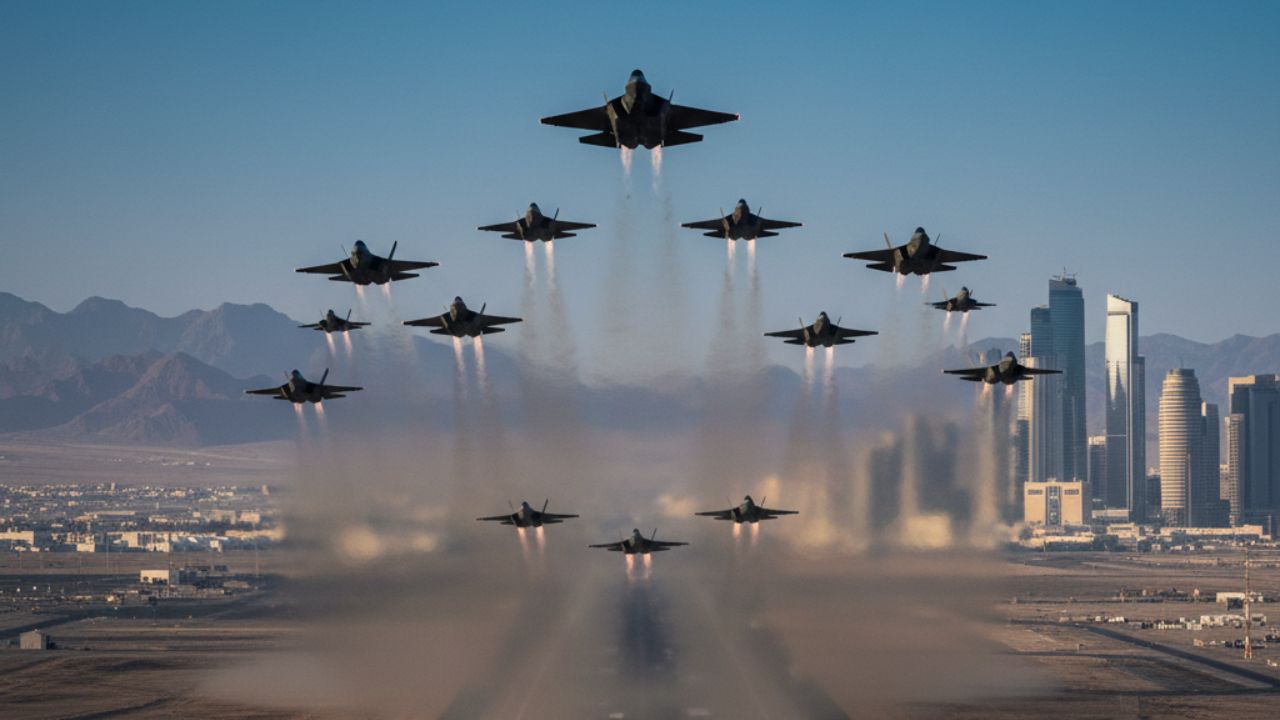
The United States has deployed more than 50 advanced fighter jets to the Middle East, even as indirect nuclear talks with Iran continue in Geneva, marking a dual-track strategy of military pressure and diplomatic engagement. This buildup underscores Washington’s effort to deter potential escalation while keeping the door open for a negotiated agreement on Iran’s nuclear program.
Overview of the new deployment
US officials say that over 50 fighter jets, including F‑22s, F‑35s, and F‑16s, have been moved toward the region within roughly a 24‑hour window. Flight‑tracking data and defense analysts report multiple waves of aircraft and aerial refueling tankers heading toward bases near Iran, indicating preparations for sustained operations rather than a brief show of force.
The air power surge is part of a broader buildup that also includes a carrier strike group and additional naval assets positioned across key chokepoints in the Middle East. US officials frame the deployment as defensive, aimed at protecting US forces, partners, and commercial shipping amid rising concerns over Iran’s nuclear advances and regional activities.
Link to ongoing Iran talks
The military moves come in parallel with a second round of indirect US‑Iran nuclear talks currently underway in Geneva, mediated in part by Omani diplomats. Negotiators from both sides say they have reached a general understanding on a set of “guiding principles” for a potential agreement, but caution that major technical and political gaps remain.
Iran’s foreign minister has described the latest discussions as “serious, constructive and positive,” noting that Tehran plans to present a more detailed proposal in the coming weeks. Washington, meanwhile, is pushing for stricter limits on uranium enrichment and stronger verification measures, while Iran insists the talks focus narrowly on the nuclear file and include meaningful sanctions relief.
Strategic message to Tehran and the region
The rapid deployment of 50-plus jets is widely interpreted as a calibrated message that diplomacy is the first choice, but force remains on the table if talks fail. President Donald Trump has signaled he will decide within weeks whether to pursue a military strike on Iran’s nuclear infrastructure should negotiations stall, while stressing that he “always wants to use diplomacy” if possible.
Regional governments are closely watching whether the buildup leads to deterrence or escalation, especially as Israel and Gulf partners urge Washington to maintain maximum pressure on Tehran’s nuclear and missile programs. Analysts warn that miscalculation—such as an attack on US forces, a strike on Gulf energy infrastructure, or an incident in key maritime corridors—could turn the current standoff into a broader confrontation.
Those tracking regional security trends can follow additional expert coverage at think‑tank and policy outlets such as the Brookings Institution and the International Crisis Group , which regularly analyze US‑Iran dynamics and Middle East military deployments.
What this means going forward
In the short term, the US jet deployment gives Washington greater flexibility to respond rapidly to any Iranian move in the air, at sea, or via regional proxies. It also strengthens US leverage at the negotiating table by signaling that time and patience are limited if Iran continues to expand its nuclear activities.
Over the medium term, much will depend on whether negotiators can turn their “guiding principles” into a detailed text that addresses enrichment limits, inspections, sanctions relief, and regional concerns. If diplomacy succeeds, the jets may serve primarily as a deterrent backdrop; if talks collapse, the same assets could form the backbone of any future US‑led military action against Iran’s nuclear infrastructure.






Leave a comment