

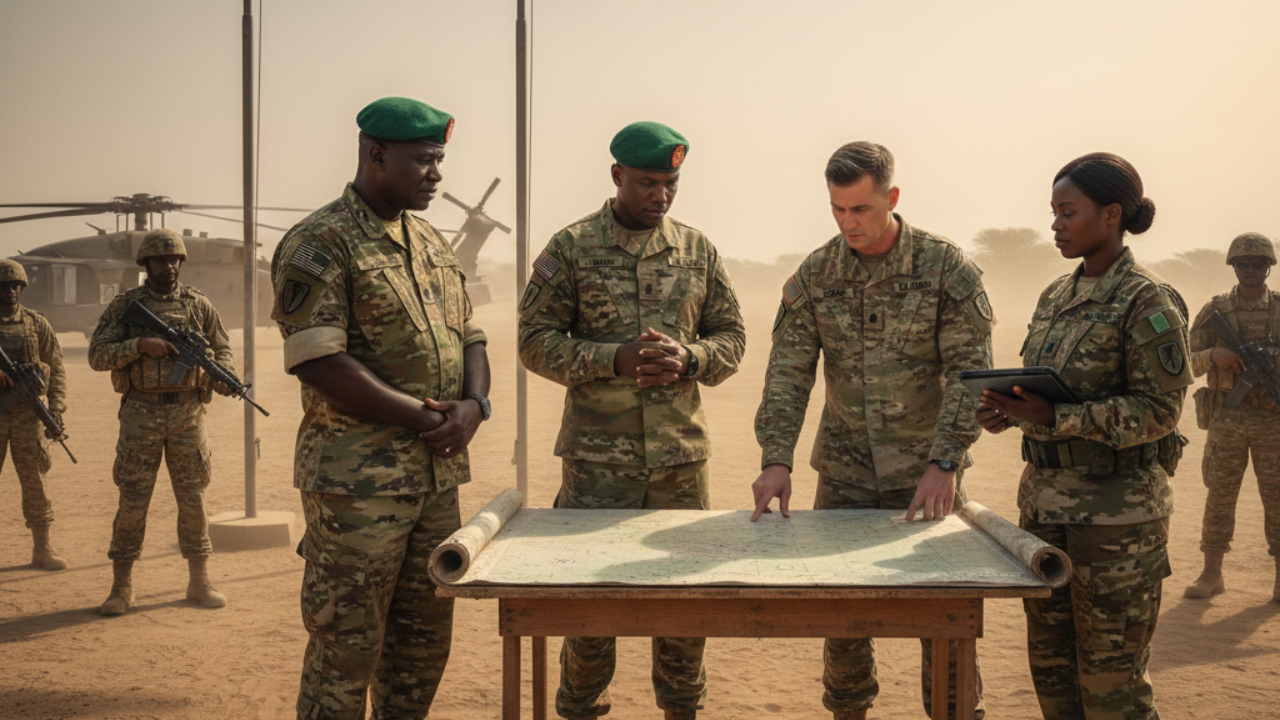
The United States has deployed a small military advisory team to Nigeria in response to a rise in attacks by jihadist groups in the country’s northeast. The move comes as Nigerian security forces face renewed pressure from armed groups linked to Boko Haram and the Islamic State West Africa Province, which have stepped up operations against both military targets and civilians.
US officials said the deployment is limited in size and focused on support rather than combat. American personnel will assist Nigerian forces with training, intelligence sharing, planning, and logistics. The United States stressed that its troops will not take part in direct fighting and that Nigerian forces will remain fully in charge of all military operations.
Nigeria has been battling Islamist insurgency for more than a decade, particularly in the states of Borno, Yobe, and Adamawa. Although the military has achieved some successes over the years, armed groups have shown resilience and adaptability. Recent attacks on military bases, convoys, and villages have raised concerns that the security situation is deteriorating again.
Officials familiar with the situation say the US decision reflects concern that militant groups are exploiting weak governance, poverty, and difficult terrain to regroup. The Lake Chad region, where Nigeria borders Niger, Chad, and Cameroon, remains a key area of instability. Violence in this region has displaced millions of people and created one of Africa’s most serious humanitarian crises.
The Nigerian government has welcomed the advisory support, describing it as part of a broader effort to strengthen the country’s ability to fight terrorism. Authorities in Abuja emphasized that the cooperation respects Nigeria’s sovereignty and is based on a request for assistance. Nigerian officials also noted that international support is important as the country deals with multiple security challenges at the same time.
For the United States, Nigeria is seen as a crucial partner in West Africa. American officials have repeatedly warned that if jihadist groups gain more ground in the region, the consequences could extend beyond Nigeria, threatening neighboring countries and regional stability. Washington has also expressed concern that extremist groups could benefit from instability in parts of the Sahel, where several countries have experienced coups and reduced cooperation with Western partners.
Humanitarian organizations have stressed that improved security is urgently needed to allow aid delivery. Many communities affected by the conflict lack access to healthcare, food, and education. Attacks on aid workers and infrastructure have made relief efforts increasingly dangerous. Aid agencies say that military measures must be combined with efforts to protect civilians and rebuild trust between local communities and security forces.
There is also skepticism about whether foreign military support can bring lasting change. Critics point out that similar advisory missions in the past have produced mixed results. They argue that corruption, weak institutions, and lack of economic opportunities continue to fuel instability and recruitment by armed groups. Without addressing these underlying issues, they warn, military gains may not be sustainable.
The US advisory deployment is expected to be reviewed regularly, with its scope adjusted depending on developments on the ground. Both countries say the goal is to reduce violence, improve coordination, and strengthen Nigeria’s long-term capacity to manage its own security.
As attacks continue and civilians remain at risk, the situation highlights the complexity of fighting insurgency in the region. While the arrival of US advisers signals renewed international engagement, the outcome will depend largely on Nigeria’s ability to combine security efforts with political, social, and economic reforms.








Leave a comment