

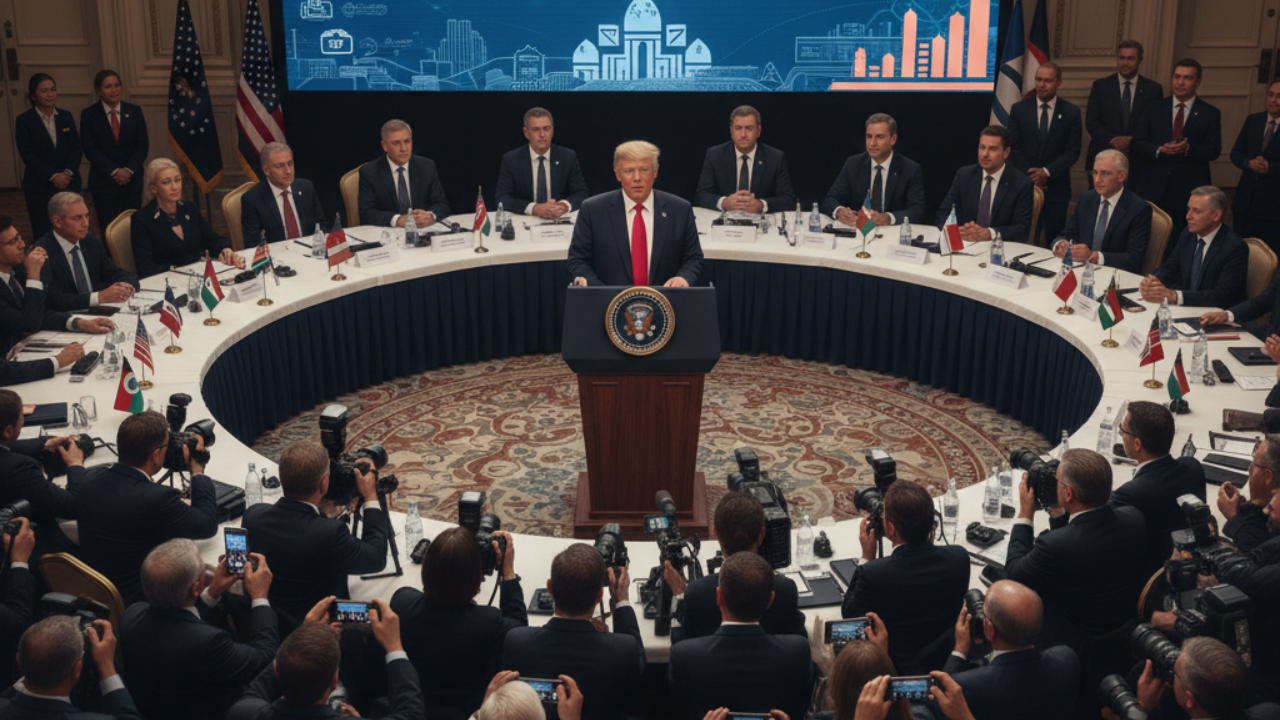
U.S. President Donald Trump has announced that member states of his newly created Board of Peace have pledged more than 5 billion dollars to support Gaza’s reconstruction and humanitarian needs, marking one of the largest coordinated aid promises for the war‑torn enclave since the ceasefire took hold in late 2025. The funding is expected to be unveiled formally at the Board’s first official meeting in Washington, underscoring how central Gaza has become to Trump’s broader regional peace and security agenda.
Board of Peace pledges over $5B for Gaza
In a recent statement, Trump said countries sitting on the Board of Peace will commit “over $5 billion” to rebuild critical infrastructure in Gaza and to expand humanitarian relief operations for its displaced population. The pledges will be showcased at a high‑profile gathering at the Donald J. Trump Institute of Peace, where heads of state and senior ministers from more than 20 countries are expected to attend. According to the White House, the Board will oversee how funds are allocated and monitored, aiming to channel money directly into vetted projects rather than through intermediaries that Washington views as ineffective or politicized.
Trump has framed the package as both a moral obligation and a strategic investment, arguing that large‑scale reconstruction is essential to prevent renewed radicalization in Gaza and to stabilize the wider region. He has also tied the aid to strict security benchmarks, insisting that Hamas and other armed groups must fully disarm as part of the broader Gaza peace plan endorsed by a United Nations Security Council resolution.
What the money is supposed to cover
The announced $5 billion plus is intended to finance a mix of reconstruction and emergency relief, including housing, electricity, water, basic services, and medical facilities. Much of Gaza’s urban fabric was devastated during more than two years of Israeli bombardment, with international damage assessments estimating that total rebuilding could ultimately cost around 70 billion dollars. Against that backdrop, the Board’s pledges amount to an initial down payment, rather than a full solution, but one that could unlock further international support if early projects show tangible progress on the ground.
Under Trump’s Gaza peace plan, a National Committee for the Administration of Gaza, led by Palestinian technocrats and backed by the Board of Peace, is expected to manage day‑to‑day governance and oversee key reconstruction contracts. The goal is to create a more accountable, internationally supervised structure that can coordinate with major donors, regional partners, and development institutions such as the World Bank and UN agencies. For readers seeking deeper background on the economic and governance pillars of the plan, the Council on Foreign Relations provides a detailed guide to the 20‑point Gaza peace framework and its implementation challenges.
Security force and political conditions
Beyond money, Trump says Board of Peace members have agreed in principle to send thousands of personnel for a UN‑authorized stabilization force and to help train and staff a reformed Palestinian police service in Gaza. The international force is intended to guarantee a demilitarized environment, enforce the ceasefire lines, and support the removal of weapons, tunnels, and military infrastructure left by Hamas and other factions. However, only a small number of states, including Indonesia, have so far signaled readiness to contribute significant troop numbers, highlighting how politically sensitive deployment to Gaza remains.
Trump’s team stresses that the financial pledges and security arrangements are tightly linked to Hamas’ full demilitarization and exclusion from Gaza’s future governance architecture. The plan envisions Gaza as a “deradicalized, terror‑free zone” under temporary international supervision, with a pathway toward Palestinian self‑determination if benchmarks on security and institutional reform are met. Analysts at institutions such as Rice University’s Baker Institute note that this sequencing—security first, then reconstruction and limited political horizon—will be a key test of the plan’s viability.
Is $5B enough for Gaza’s recovery?
In scale, the Board of Peace pledges are significant but still far below the estimated total cost of rebuilding Gaza’s housing, infrastructure, and economy. UN‑backed assessments suggest that full reconstruction could exceed 70 billion dollars and take decades, given the extent of physical destruction and the loss of productive capacity across the territory. The new commitments therefore function as a starting tranche that could be expanded if the ceasefire holds, donor confidence improves, and projects demonstrate transparent use of funds.
For Gaza’s civilians, the immediate impact of the pledges will depend on how quickly money is disbursed, which projects are prioritized, and whether restrictions on movement and imports are eased enough to allow reconstruction materials to enter. Humanitarian organizations, including many working under the UN umbrella, have long warned that without sustained financing and political access, even large one‑off commitments risk falling short of transforming living conditions in the enclave. For more context on the scale of the challenge, UN reports on Gaza’s damage assessment and long‑term recovery prospects are available through official UN and UNCTAD publications.
What to watch next
Observers will be closely watching Thursday’s Board of Peace meeting for details on which states are contributing how much, what share of funds is earmarked for emergency relief versus long‑term projects, and how fast the first tenders will be launched. The makeup of the international stabilization force, including whether major regional players such as Türkiye, Egypt, Qatar, Saudi Arabia, and Israel align on rules of engagement, will also shape the plan’s success or failure. As the Gaza peace plan moves from paper to implementation, the $5 billion pledge is emerging as an early barometer of whether Trump’s Board of Peace can translate ambitious promises into concrete change on the ground.







Leave a comment