

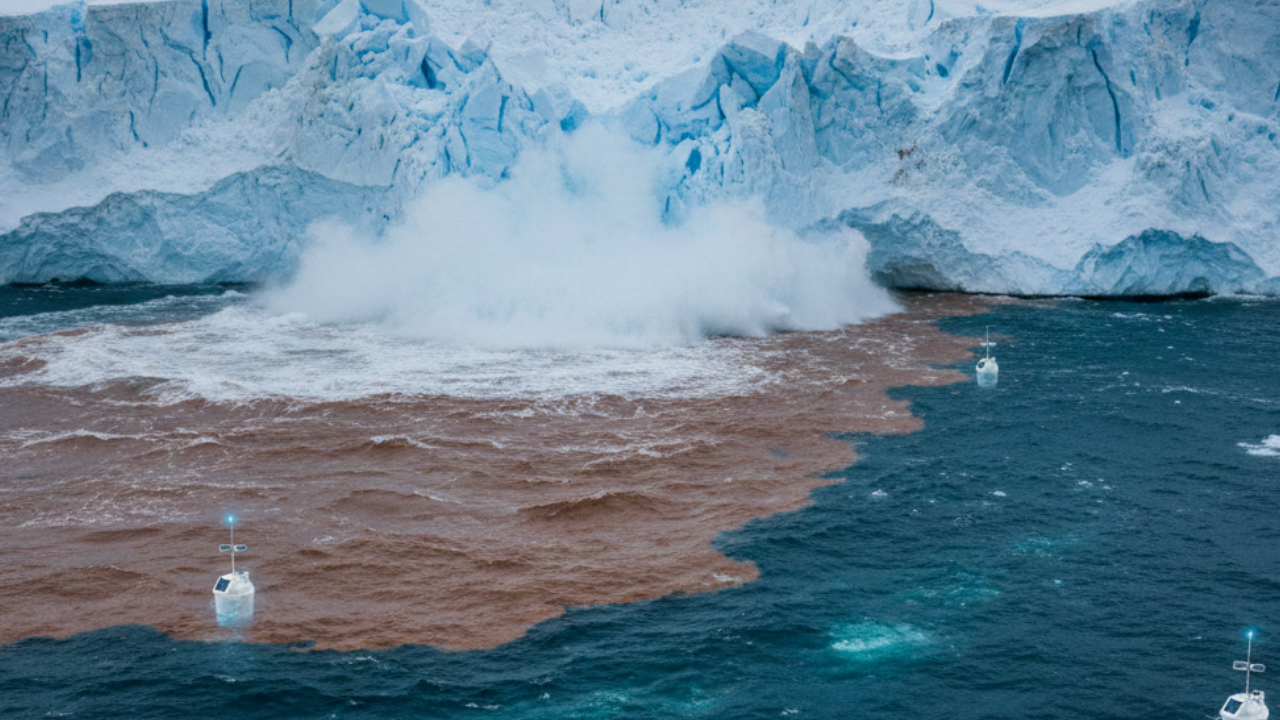
Rutgers University scientists have overturned a widely held theory that melting Antarctic glaciers could help slow climate change, showing instead that the process offers little natural relief from rising carbon emissions.
What the Rutgers study found
Researchers from Rutgers University–New Brunswick made the most precise measurements yet of iron flowing from an Antarctic ice shelf into the surrounding Southern Ocean. For years, many scientists believed that as glaciers melted, iron trapped in the ice would fertilize microscopic algae, or phytoplankton, which absorb carbon dioxide as they grow. This “iron fertilisation” idea was seen as a potential natural brake on climate change, especially in the remote but globally important Southern Ocean.
The new measurements tell a very different story. The team found that meltwater from the Dotson Ice Shelf in West Antarctica carries far less bioavailable iron than previous models assumed. In fact, they report that the concentration of iron in the meltwater is several times lower than earlier estimates, sharply limiting its capacity to stimulate large-scale carbon‑absorbing plankton blooms.
Why the iron fertilisation theory is weakened
The Rutgers-led study shows that most of the iron reaching nearby waters does not come directly from the melting ice itself. Instead, much of it is released from bedrock beneath the glacier, where low‑oxygen meltwater helps dissolve iron minerals before they mix into the ocean. This means that the key driver of sea‑level rise—the loss of floating ice shelves and outlet glaciers—is not simultaneously delivering a powerful climate “bonus” in the form of extra iron.
Because earlier climate projections often assumed generous iron inputs from glacial melt, the new data undermine the idea that warming‑driven ice loss could significantly boost ocean carbon uptake. The findings suggest that some Earth system models may have overstated this negative feedback, and that the Southern Ocean’s ability to buffer human emissions is more limited than hoped. As Euronews notes in its coverage, a once “long‑standing silver lining” in an otherwise bleak climate outlook now appears much dimmer.
For readers wanting background on iron fertilisation and Southern Ocean carbon uptake, NASA’s Earth Observatory offers accessible explainers on how phytoplankton and nutrients regulate the global carbon cycle (for example, see their overview of ocean “biological pumps”).
Implications for climate projections
The Southern Ocean plays an outsized role in absorbing both heat and carbon dioxide from the atmosphere, so small changes in its chemistry can have global consequences. If glacial melt contributes less iron than expected, then the ocean’s natural capacity to draw down CO₂ may grow more slowly in a warming world than some scenarios predicted. That, in turn, means policymakers cannot count on polar processes to compensate for continued high emissions.
At the same time, other recent Rutgers‑linked research shows that melting ice can accelerate sea‑level rise and local warming in ways that are still not fully captured in models. For example, studies on underwater glacial melt and surface meltwater pools in Greenland indicate ice is disappearing faster than older projections suggested. Together, these lines of evidence reinforce a stark message: ice loss is primarily a threat multiplier for climate change, not a solution.
The Intergovernmental Panel on Climate Change (IPCC) has repeatedly warned that limiting warming to well below 2 degrees Celsius requires rapid, sustained cuts in greenhouse‑gas emissions, not reliance on unproven natural offsets. Readers can explore the IPCC’s latest assessment reports for broader context on ice sheets, oceans, and future warming pathways.
What this means going forward
For climate scientists, the Rutgers study underscores the need to refine how models represent iron sources, glacial melt, and Southern Ocean ecosystems. More field campaigns in Antarctica and other polar regions will be needed to pin down how much iron different glaciers release, how quickly phytoplankton respond, and how these processes evolve as the planet warms.
For the wider public and decision‑makers, the takeaway is clear. Expectations that melting glaciers might naturally offset part of humanity’s carbon footprint are now on much shakier ground. Instead of a helpful cooling mechanism, Antarctic melt must be understood mainly as a driver of sea‑level rise and a sign of an accelerating climate crisis.









Leave a comment