

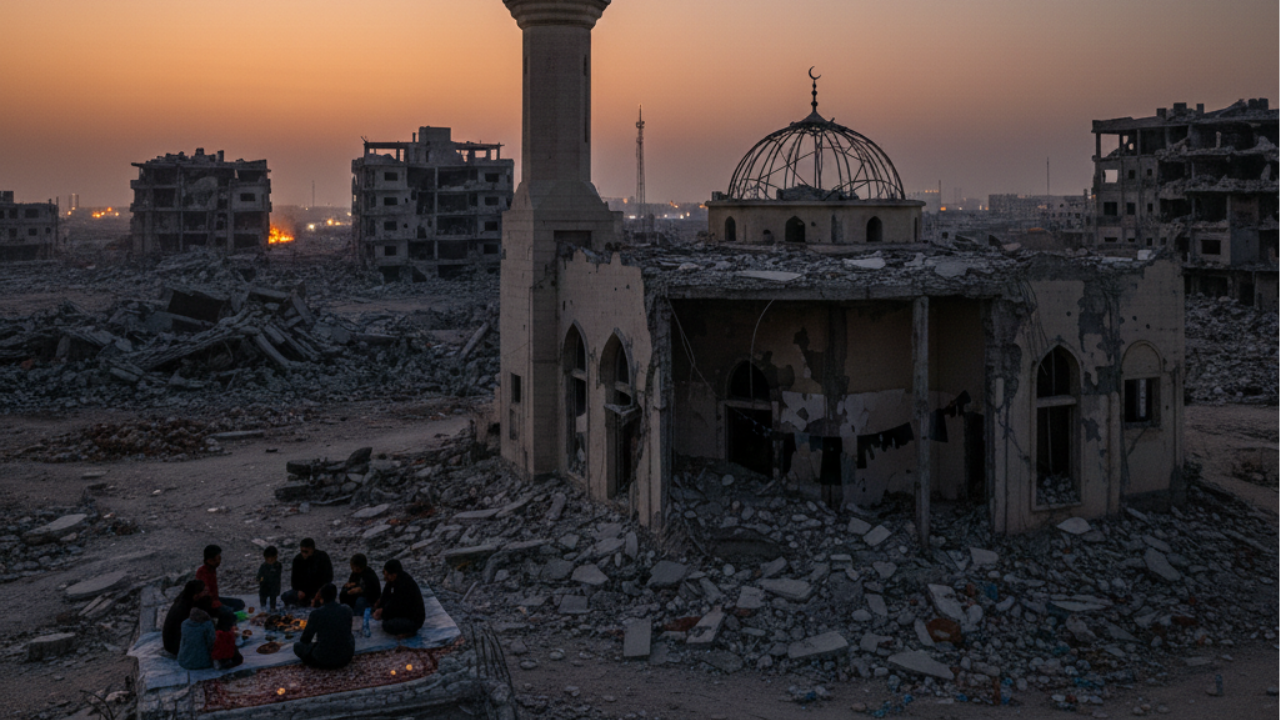
Ramadan has begun in Gaza under the shadow of vast destruction, with many Palestinians welcoming the holy month among the ruins of shattered mosques and overcrowded displacement camps. Instead of the usual atmosphere of community worship and family gatherings, this year’s Ramadan is marked by grief, scarcity, and the struggle to preserve faith amid ongoing devastation.
Holy month amid destroyed mosques
As the new moon marked the start of Ramadan, worshippers in Gaza headed not to fully lit mosques but to broken structures and makeshift prayer spaces built from wood and plastic sheets. In Gaza City, the dome of the Al Hassaina mosque now rests on a pile of rubble, its courtyard turned into a temporary shelter where displaced families sleep, cook, and hang their clothes between shattered columns.
Local religious officials say hundreds of mosques across the Strip have been completely destroyed and many more partially damaged, forcing people to “pray in tents” or under tarpaulins stretched across bombed-out courtyards. For many Palestinians, the loss is both spiritual and communal, as these mosques once hosted thousands for Taraweeh prayers, Quran circles, and iftar gatherings every evening of the holy month.
Displacement and life in tents
Two years of intense Israeli bombardment and ground operations have pushed the majority of Gaza’s population into displacement, with more than a million people living in crowded tent camps or makeshift shelters. According to UN estimates, around two thirds of Gazans are now packed into roughly 1,000 sites, where privacy is almost nonexistent and basic services—sanitation, electricity, and clean water—are severely limited.
In these camps, Ramadan nights that once echoed with family visits and lantern-lit streets are now quieter, broken by the noise of generators, distant explosions, and the sounds of children playing among the debris. Residents describe gatherings where familiar faces are missing, homes no longer stand, and conversations focus more on survival and loss than on celebration and festivity.
Struggle to afford iftar and suhoor
The economic situation in Gaza has turned the simple act of preparing iftar and suhoor into a daily challenge. Restrictions on the entry of goods and the collapse of local production have pushed food prices to unprecedented levels, with some items rising by several hundred percent and many families unable to afford even a basic meal.
Humanitarian organisations warn that many Gazans are beginning Ramadan with almost no capacity to buy staples such as flour, oil, rice, and dates, even when they are available in shops. Agencies like the World Food Programme report that community kitchens now serve hundreds of thousands of hot meals daily, often the only way families can break their fast with dignity in the absence of stable income or sufficient aid. For a deeper look at these humanitarian dynamics, readers can consult UN News’ coverage on Gaza’s Ramadan hardships.
Faith, resilience and altered rituals
Despite the destruction, Palestinians in Gaza are determined to hold on to the core spiritual meanings of Ramadan—patience, gratitude, and solidarity with the vulnerable. Families still gather at sunset to share whatever food they can, reciting Quran by the light of lanterns and phones, and encouraging children to keep up traditions even as their surroundings have radically changed.
Religious leaders and volunteers are working to rebuild small prayer areas within the ruins of mosques, clearing corners of rubble and using salvaged wood and plastic to create clean spaces for congregational worship. Many Gazans say that while the joy of Ramadan now “carries grief within it,” the month also deepens their sense of unity and reliance on God in the face of ongoing loss.
Calls for humanitarian access and reconstruction
International organisations continue to warn that current levels of aid entering Gaza are far below what is required for a population facing war damage, displacement, and a collapsing economy. Humanitarian officials argue that regular, predictable access through all available crossings is essential if families are to complete Ramadan with basic dignity, including sufficient food, clean water, and shelter.
At the same time, local authorities and community groups have begun small-scale efforts to clear debris and repair religious sites, but the scale of destruction means full reconstruction will take years without significant external support. Readers who want to follow ongoing developments and relief efforts can refer to detailed reports from outlets such as Al Jazeera and Reuters for continuous updates and analysis.








Leave a comment