

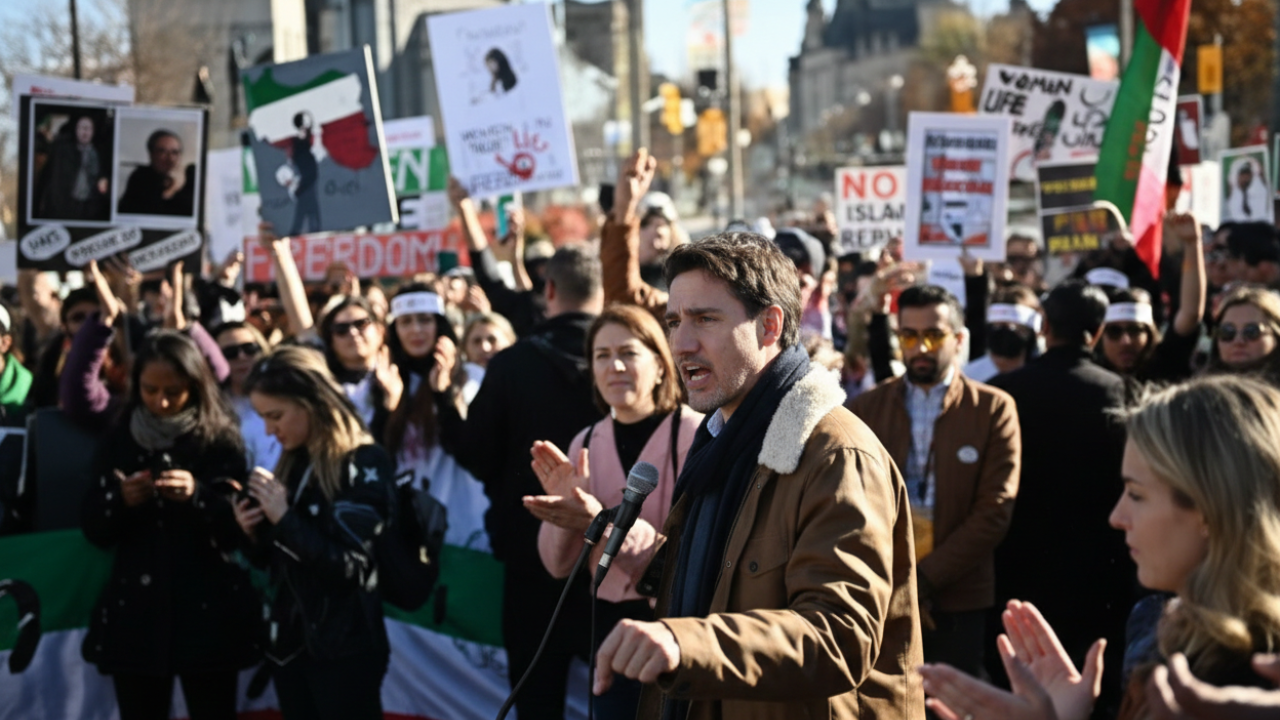
Protests across Canada are escalating as demonstrators demand a far tougher policy toward Iran, urging Ottawa to move beyond symbolic statements and adopt concrete measures against the Islamic Republic’s leadership and security apparatus.
Growing Wave of Protests in Canadian Cities
In recent weeks, major Canadian cities such as Toronto and Vancouver have seen massive rallies in solidarity with Iranians who are facing violent crackdowns at home. Toronto’s latest “Day of Action” brought an estimated 350,000 people into the streets, with another 50,000 marching in Vancouver, calling for an end to repression in Iran and justice for victims of state violence. Many protesters carried photos of those killed in Iran and waved pre‑revolutionary flags, underscoring their rejection of the current regime in Tehran.
Demonstrators say they are no longer satisfied with expressions of concern from foreign governments and want Canada to take a clear stand for democratic change. Chants at these rallies frequently call for the dismantling of Iran’s Islamic Republic and, in some cases, support a transition led by opposition figures in exile.
What Protesters Want From Ottawa
At the heart of the protests is a growing belief that Canadian policy has not kept pace with the severity of abuses in Iran. Activists argue that diplomacy and limited sanctions have failed to deter Tehran from imprisoning dissidents, shooting protesters, and exporting repression beyond its borders. They want Ottawa to adopt a strategy that prioritizes human rights and democratic change over narrow engagement with the regime.
Key demands include:
- Expanding and enforcing targeted sanctions on senior Iranian officials, Revolutionary Guard commanders, and regime-linked entities with assets or family ties in Canada.
- Investigating and, where appropriate, prosecuting Iranian expats in Canada who may be connected to Tehran’s repression apparatus, money laundering, or intimidation of dissidents.
Many in the Iranian‑Canadian community also insist that Canada should formally recognize the legitimacy of the Iranian people’s struggle for regime change, a step some analysts say would send a powerful political signal to Tehran.
Ottawa’s Response and Calls for Stronger Action
The federal government has started to harden its rhetoric and expand sanctions, but protesters say the response is still too cautious. Foreign Affairs Minister Anita Anand has stated that Canada does not intend to restore diplomatic relations with Iran and has openly linked any future normalization to a change of government in Tehran. Ottawa has now sanctioned more than 200 individuals and over 250 entities tied to Iran’s security and repression networks under its Special Economic Measures regulations.
However, pressure from the streets and from human rights advocates continues to grow. Critics point to longstanding loopholes that allowed regime-aligned elites to invest in Canadian real estate and use the country as a safe haven, even as ordinary Iranians faced deportation or visa hurdles. Activists argue that closing these gaps—by aggressively enforcing sanctions and vetting individuals linked to the Islamic Revolutionary Guard Corps (IRGC)—is essential if Canada wants to align its domestic policies with its public condemnation of Iran’s abuses.
For readers interested in deeper policy analysis, think tanks such as the Macdonald-Laurier Institute and organizations like Human Rights Watch regularly publish detailed reports on Canada–Iran relations and human rights trends worldwide.
Iranian Diaspora at the Center of the Movement
Iranian‑Canadians are driving much of this mobilization, combining personal grief with political advocacy. Many have relatives who were killed or jailed in recent crackdowns, and others are still seeking accountability for tragedies like the downing of Flight PS752, which claimed the lives of 176 passengers, including large numbers of Canadian citizens and residents. For them, Canada’s stance on Iran is not an abstract foreign‑policy question but a test of whether the country will stand with victims of authoritarian violence.policyoptions.
Community leaders stress that a stronger policy toward Iran must be paired with continued support for ordinary Iranians seeking refuge. They call on Ottawa to make it easier for dissidents and at‑risk families to secure visas and resettlement, even as Canada closes its doors to officials and proxies of the regime. By tightening sanctions, investigating regime-linked networks, and backing the Iranian people’s demand for freedom, protesters say Canada can play a meaningful role in shaping the outcome of Iran’s historic uprising.policyoptions.
For additional background on protests in Iran and Canada’s evolving policy debate, readers can consult in‑depth features from Canadian outlets such as CBC News and Global News, which track both domestic rallies and developments inside Iran.






Leave a comment