

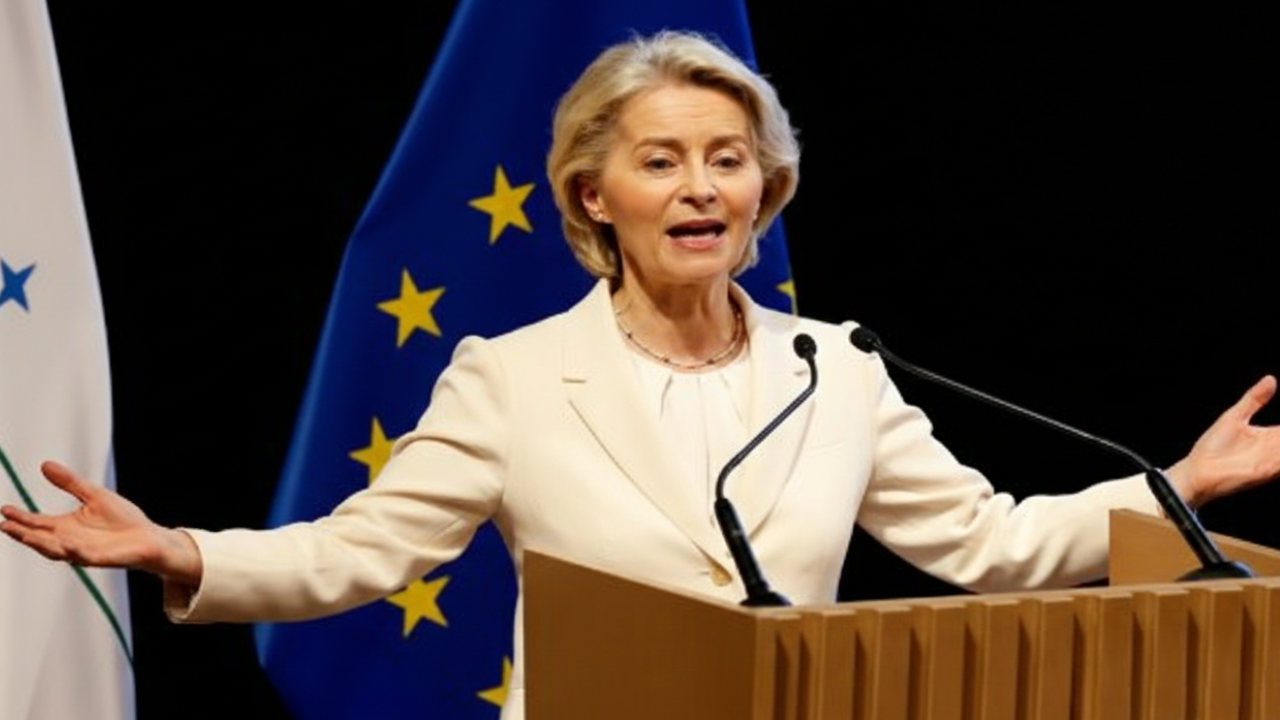
EU leaders, led by Ursula von der Leyen, are pushing a new political line: simplify and streamline EU rules, deepen the single market, and cut red tape so Europe can better match the scale and speed of the U.S. and China.
What EU leaders are saying
- Von der Leyen argues that Europe’s fragmented rulebook and capital markets are holding back growth, productivity, and innovation versus the U.S. and China.
- She highlights that the U.S. effectively has one financial system and one main financial centre, while the EU has 27 systems and more than 300 trading venues, which she calls “fragmentation on steroids.
Core goal: a deeper single market
- Von der Leyen plans to ask leaders to endorse a roadmap to complete and deepen the EU single market by 2028, including a clearer timetable for integration measures.
- Former Italian premiers Mario Draghi and Enrico Letta will brief leaders, building on their 2024 reports that argue a fully integrated single market is essential for scale and competitiveness.
Cutting red tape and simplifying rules
- The Commission has launched or planned multiple “omnibus” simplification packages that together aim to cut compliance costs for companies by roughly €13 billion a year.
- Recent and upcoming files include a simplification package on chemicals, streamlined product rules, and efforts to standardise company registration and reporting so firms face fewer overlapping national requirements.
Industrial and innovation agenda
- A forthcoming Industrial Accelerator Act is being prepared, with ideas such as local-content (“Made in Europe”) requirements in public procurement and targeted subsidies for sectors like steel, cement, aluminium and clean-tech equipment.
- A European Innovation Act and a so‑called “28th Regime” are planned to make it possible to create and register a company digitally within 48 hours on a once‑only basis and to ease cross‑border scaling.
Competing with the U.S. and China
- Leaders see regulatory simplification as part of a broader competitiveness strategy alongside state aid, a larger Savings and Investment Union capital market, and possible “Buy European”‑style tools to reduce strategic dependence on China in key technologies.
- The EU is also moving on a “Made in Europe” / “Made with Europe” industrial approach in public contracts and climate‑related policies (for example changes to the carbon market and CBAM) to protect domestic industry while staying open to trade.
Internal disagreements among member states
- France, under Emmanuel Macron, pushes for large common borrowing, stronger “Made in Europe” conditions, and more muscular industrial policy.
- Germany and several northern states resist broad protectionist moves or big new joint debt, preferring productivity reforms, more trade deals, and targeted short‑term support in only a few strategic sectors.








Leave a comment