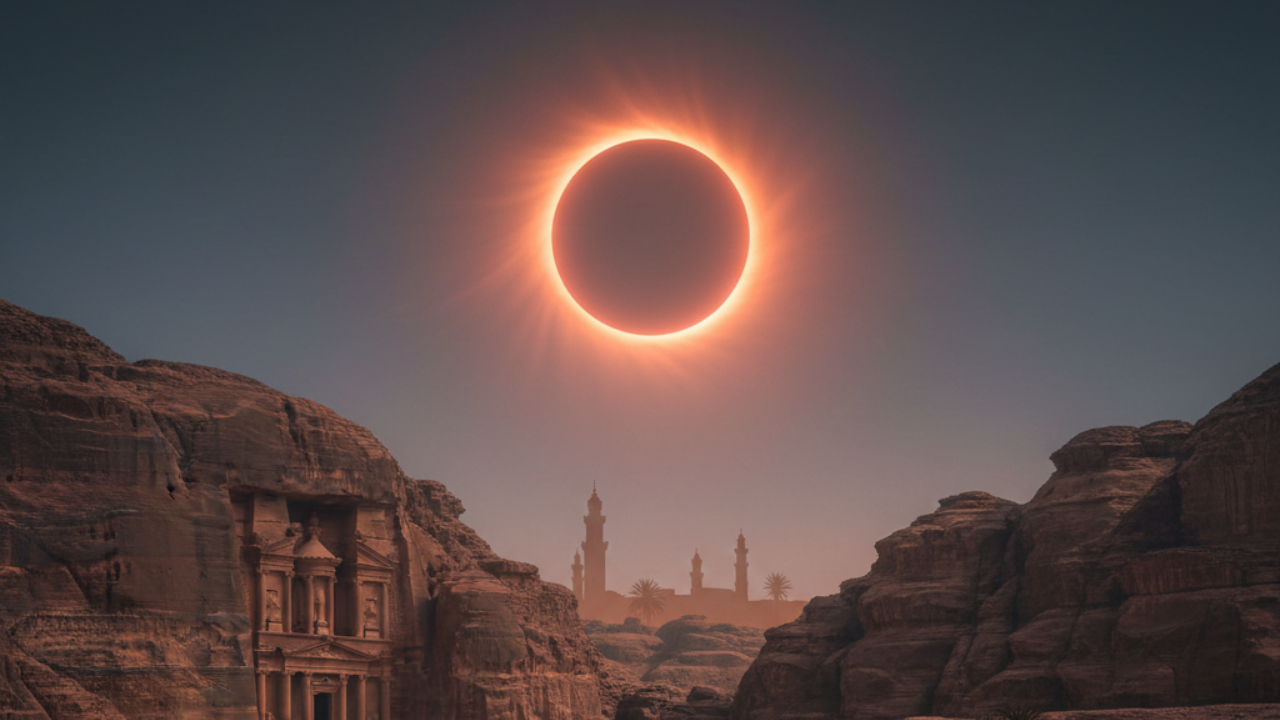
Skywatchers across the Middle East recently experienced one of nature’s most breathtaking celestial displays: an annular solar eclipse, often called the “Ring of Fire.” Unlike a total solar eclipse, where the moon completely blocks the sun, an annular eclipse occurs when the moon passes directly in front of the sun but appears slightly smaller from Earth’s perspective. This size difference leaves a brilliant ring of sunlight visible around the moon’s dark silhouette.
The phenomenon attracted widespread attention across countries in the region. Astronomy organizations and educational institutions organized public viewing events, encouraging families and students to witness the rare spectacle safely. Observatories reported increased engagement, with many young people expressing newfound curiosity about space science.
Safety was a key priority. Authorities consistently warned against looking directly at the sun without certified eclipse glasses. Eye specialists reminded the public that even brief exposure to direct sunlight during an eclipse can cause permanent retinal damage. As a result, eclipse-viewing glasses and solar filters were in high demand days before the event.
From a scientific standpoint, annular eclipses are predictable events. Astronomers can calculate their exact timing years in advance using orbital mechanics. However, predictability does not reduce their emotional impact. Many observers described the experience as surreal — daylight dimmed slightly, temperatures dropped marginally, and an unusual calm settled over viewing locations during peak alignment.
In several Middle Eastern cities, the eclipse became a communal experience. Rooftops, open parks, and desert landscapes turned into informal observatories. Photographers captured dramatic images of the glowing solar ring against clear skies, and social media platforms were flooded with stunning visuals.
Beyond the beauty of the moment, astronomers used the event as an educational opportunity. Public lectures explained how the moon’s elliptical orbit around Earth creates variations in apparent size. When the moon is at a point farther from Earth (apogee), it appears smaller, leading to the annular effect instead of a total blackout.
Eclipses have historically carried cultural and spiritual significance in many civilizations. In ancient times, solar eclipses were often viewed with fear or interpreted as supernatural signs. Today, scientific understanding has replaced superstition, yet the sense of awe remains unchanged.
The event also sparked conversations about regional scientific collaboration. Space agencies and research institutions across the Middle East have increasingly invested in astronomy and satellite technology. Public interest in events like eclipses supports broader ambitions to develop advanced research programs.
For many families, the eclipse was more than a scientific event — it was a shared memory. Parents lifted children to see the sky safely through filtered lenses, teachers explained cosmic mechanics in real time, and communities gathered simply to marvel at the precision of the universe.
In the end, the “Ring of Fire” eclipse served as a reminder of humanity’s place within a vast cosmic system. While political and social issues dominate daily headlines, moments like these reconnect people to something universal and timeless — the predictable yet astonishing dance of celestial bodies across the sky.

International
 Waqar WashingtonFebruary 17, 20262 Mins read
Annular Solar Eclipse Creates “Ring of Fire” Spectacle Across the Middle East
Skywatchers across the Middle East recently experienced one of nature’s most breathtaking celestial displays: an annular solar eclipse,
Waqar WashingtonFebruary 17, 20262 Mins read
Share


Related Articles

International Waqar WashingtonFebruary 26, 2026
Space Force Halts Vulcan Rocket Launches After Solid Booster Anomaly
The U.S. Space Force has paused future Vulcan rocket launches after a...
Waqar WashingtonFebruary 26, 2026

International Waqar WashingtonFebruary 26, 2026
Rutgers Study Debunks Myth That Melting Glaciers Could Help Slow Climate Change
Rutgers University scientists have overturned a widely held theory that melting Antarctic...
Waqar WashingtonFebruary 26, 2026

International Waqar WashingtonFebruary 26, 2026
Hidden Architecture Inside Cellular Droplets: Scripps Research Uncovers New Drug Targets for Cancer and Neurodegenerative Diseases
Scripps Research scientists have uncovered a hidden internal structure inside cell “droplets,”...
Waqar WashingtonFebruary 26, 2026

International Waqar WashingtonFebruary 26, 2026
Oil holds near 7-month highs as US-Iran talks open in Geneva
Oil prices are trading near seven-month highs as traders closely watch the...
Waqar WashingtonFebruary 26, 2026



Leave a comment