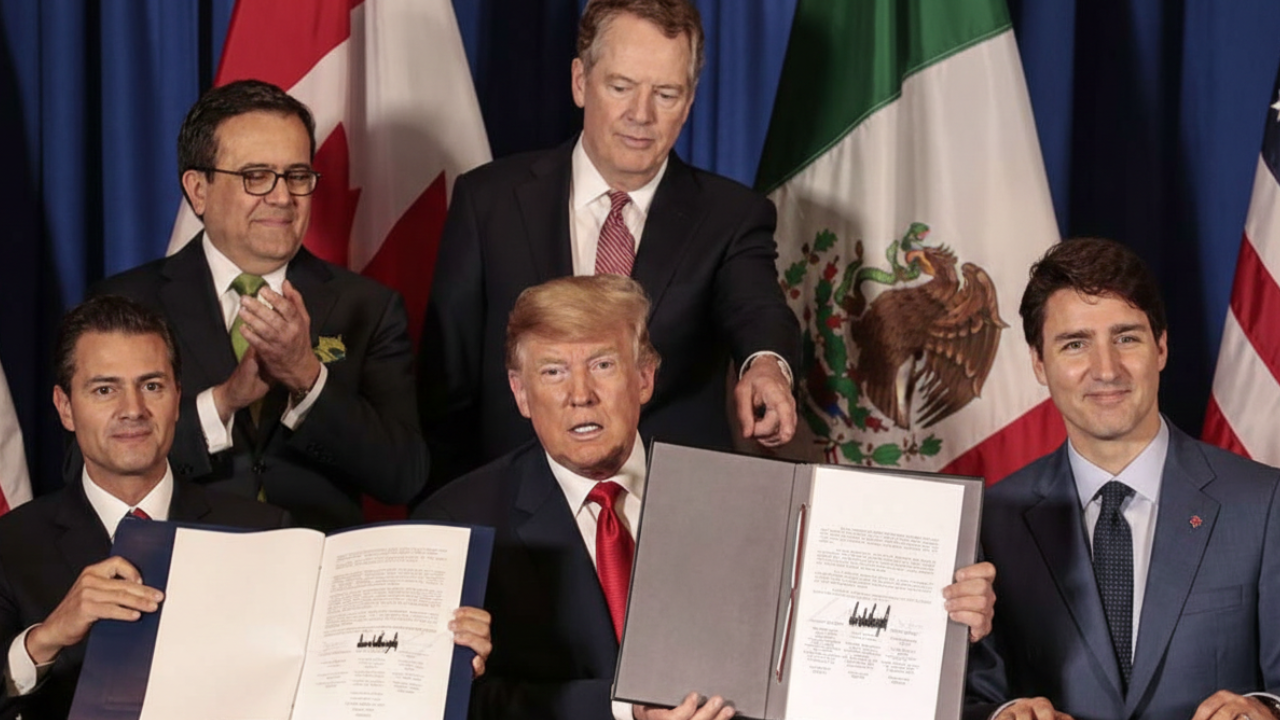
Uncertainty has emerged regarding the future direction of the United States–Mexico–Canada Agreement (USMCA), as political debates intensify across North America. The trade pact, which replaced NAFTA in 2020, governs trilateral trade among the three countries and covers sectors ranging from agriculture and automotive manufacturing to digital services.
Recent political discussions in the United States have raised questions about potential renegotiation or stricter enforcement of certain provisions. Some policymakers argue that revisions are necessary to protect domestic industries and address trade imbalances. Others warn that reopening negotiations could disrupt economic stability and supply chains.
Mexico and Canada have expressed interest in maintaining predictable trade relations, emphasizing the agreement’s importance for regional economic integration. The USMCA has facilitated billions of dollars in annual trade, supporting millions of jobs across the three economies.
One area of debate involves labor and environmental standards. The agreement includes enforcement mechanisms designed to ensure fair competition and improved working conditions. Trade officials continue reviewing compliance measures to determine whether additional oversight is required.
The automotive sector remains particularly sensitive. Rules of origin requirements under the USMCA mandate that a certain percentage of vehicle components must be manufactured within North America to qualify for tariff-free trade. Industry leaders have called for clarity to ensure long-term investment planning.
Agricultural trade also plays a significant role in the agreement. Farmers in all three countries depend on cross-border market access. Any policy uncertainty could affect commodity prices and export volumes.
Economic analysts caution that destabilizing regional trade arrangements may have broader global consequences. North America functions as a highly integrated production hub, and sudden policy shifts could disrupt manufacturing networks.
Political cycles influence trade rhetoric. Election seasons often amplify protectionist messaging, even if formal policy changes remain limited. Businesses typically seek reassurance that agreements will remain stable.
At the same time, supporters of reform argue that periodic review is healthy for ensuring that trade rules adapt to evolving economic conditions, including digital commerce and green energy transitions.
The USMCA contains built-in review mechanisms scheduled in coming years. These reviews will provide structured opportunities to assess effectiveness and propose amendments.
For now, trade flows continue under existing provisions. However, uncertainty surrounding political intentions has led to cautious monitoring by investors and multinational corporations.
The future of the USMCA will likely depend on balancing domestic political pressures with the economic benefits of regional integration. Stability remains critical for industries that rely on seamless cross-border supply chains.

International
 Waqar WashingtonFebruary 15, 20262 Mins read
Uncertainty Surrounds Future of USMCA Trade Agreement Amid Political Debate
Uncertainty has emerged regarding the future direction of the United States–Mexico–Canada Agreement (USMCA), as political debates intensify across North America.
Waqar WashingtonFebruary 15, 20262 Mins read
Share


Related Articles


ActiveInternationalUncategorized Waqar WashingtonMay 13, 2026
Godly movement or divisive ideology? New survey reveals what UK Christians think of Christian nationalism
A recent Premier Christian News mini-survey uncovers a split among UK Christians...
Waqar WashingtonMay 13, 2026

International Waqar WashingtonMay 9, 2026
Russian Drone Kills Civilian Hours Into US-Brokered Ceasefire, Casting Doubt on Peace Efforts
A Russian drone strike killed at least one civilian in Ukraine just...
Waqar WashingtonMay 9, 2026



Leave a comment