

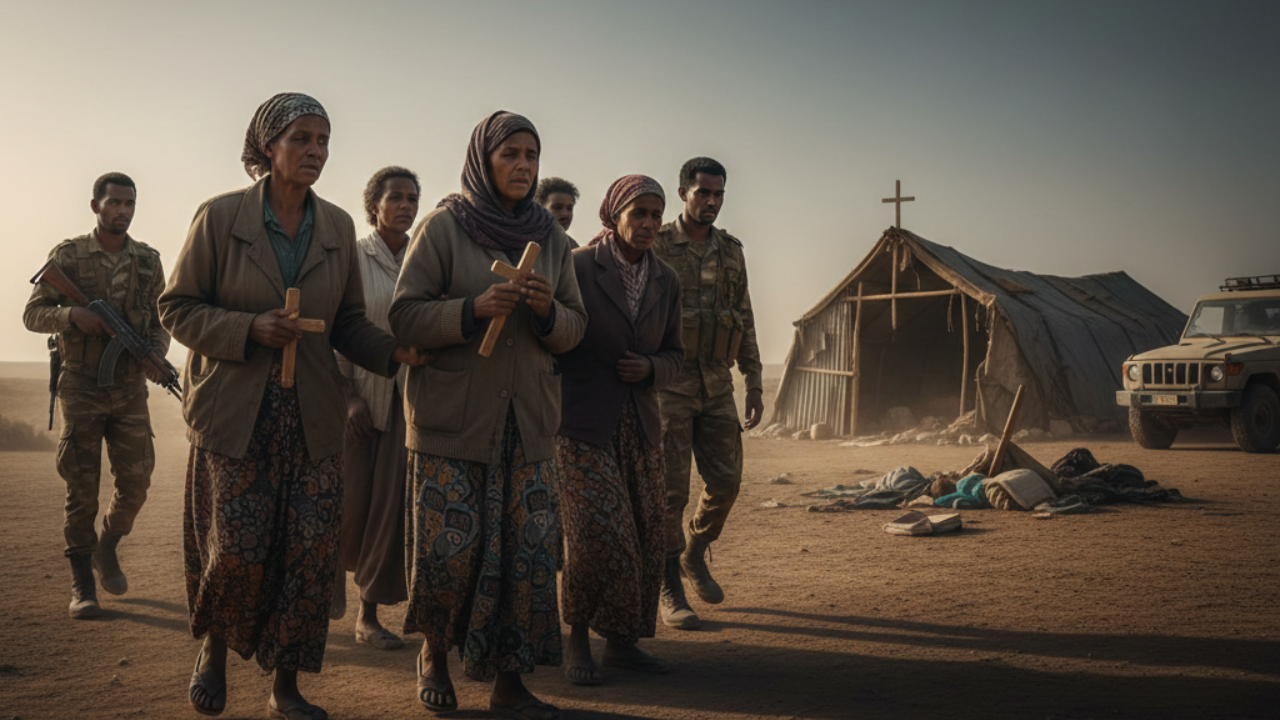
In Eritrea, Christianity is tightly controlled, selectively tolerated, and frequently punished. Often described as “Africa’s North Korea”, Eritrea enforces one of the most repressive systems of religious control in the world. For many Christians, especially those outside state-approved denominations, faith leads directly to imprisonment. Persecution in Eritrea is not sporadic. It is systematic, state-driven, and unrelenting.
A State That Decides Which Faith Is Legal
The Eritrean government officially recognises only four religious groups: the Eritrean Orthodox Church, the Roman Catholic Church, the Evangelical Lutheran Church, and Islam. All other religious communities are considered illegal. Christians who belong to independent evangelical or Pentecostal churches are labelled extremists. Their gatherings are banned. Their leaders are arrested. Their members live under constant threat of detention. Registration is theoretically possible, but in practice it is denied. This legal dead end leaves thousands of Christians criminalised simply for worshipping outside state control.
Arbitrary Arrests and Indefinite Detention
Arrests often occur during prayer meetings, home gatherings, or even private conversations. Detainees are rarely charged or tried. Instead, they are held indefinitely, sometimes for years, without legal process. Prison conditions are harsh. Former detainees describe being held in shipping containers or underground cells, exposed to extreme heat or cold. Food is scarce. Medical care is minimal or nonexistent. Release is often conditional on signing documents renouncing faith. Many refuse and remain imprisoned.
Pressure to Renounce Belief
Renunciation is a central tool of persecution in Eritrea. Prisoners are repeatedly pressured to abandon Christianity in exchange for freedom. Those who comply may be released. Those who do not are punished further. This pressure is psychological as well as physical. Prisoners are isolated from families. Information is withheld. Hope is used as leverage. Faith becomes a test of endurance.
Targeting of Church Leaders
Pastors and church leaders are particular targets. Their arrest is intended to dismantle entire communities. When leaders disappear, congregations scatter, fearful of further arrests. Some leaders have died in custody. Others remain missing, with families unaware of their whereabouts or condition.
No Independent Judiciary
Eritrea lacks an independent judicial system. Courts do not operate freely. There is no meaningful legal appeal for those arrested on religious grounds. The rule of law exists largely on paper. This absence of accountability allows security forces to act with total impunity.
International Isolation and Silence
Eritrea’s isolation shields it from sustained international pressure. While human rights organisations have documented abuses for years, access to the country is severely restricted. Independent journalists and monitors are rarely allowed entry. The United States Commission on International Religious Freedom consistently ranks Eritrea among the worst violators of religious freedom. Amnesty International and Human Rights Watch have issued repeated warnings. Yet the situation remains unchanged.
The Human Cost
For Eritrean Christians, persecution is long and quiet. Families wait years for news of loved ones. Children grow up without parents. Communities disappear without record. Faith survives in whispers and memory, often passed on silently to avoid detection.
Conclusion
Christian persecution in Eritrea is rooted in absolute state control. The government does not merely regulate religion. It decides which beliefs may exist at all. Until prisoners are released, faith is decriminalised, and legal protections are restored, Eritrea will remain one of the darkest places in the world to practise Christianity.




Leave a comment