

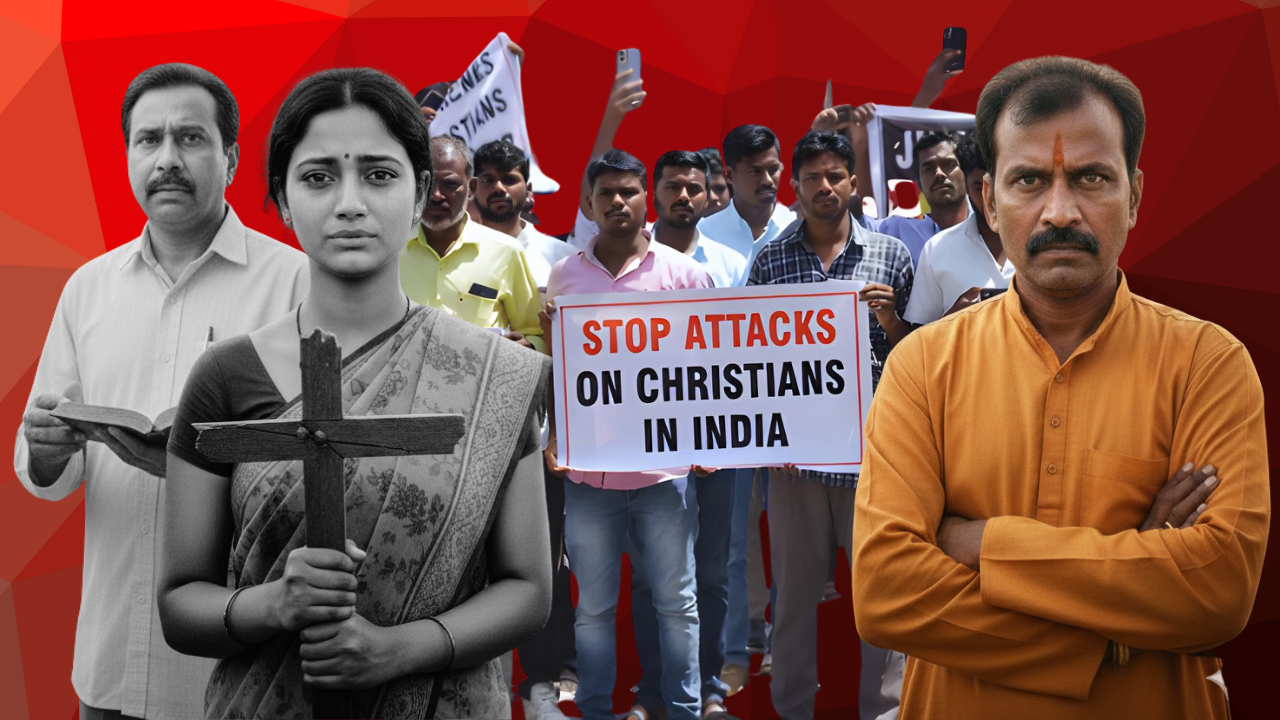
Christians in India faced an unprecedented surge in violence with more than two attacks each day in 2024, totaling 834 documented incidents—the highest in the nation’s history. This alarming figure represents a 555% increase in attacks over the past decade since 2014.
The persecutions of Christians in India reached a disturbing peak during Christmas 2025, when numerous incidents of intimidation, harassment, and disruption of celebrations were reported across the country. Despite Article 25 of India’s Constitution guaranteeing all citizens the freedom to “profess, practice and propagate religion”, the Church of South India made a shocking statement: “Until now, we have never witnessed so many incidents, especially on Christmas Day or during Christmas celebrations”.
In this article, we will examine the recent wave of attacks on Christian communities, explore reactions from church leaders, analyze the troubling trends in religious persecution, and discuss the gap between constitutional rights and the reality faced by religious minorities in India.
A Season of Fear: What Happened During Christmas 2025
“These targeted incidents, especially against peaceful carol singers and congregations gathered in churches to pray, gravely undermine India’s constitutional guarantees of freedom of religion and the right to live and worship without fear.” — Catholic Bishops Conference of India (CBCI), Official body representing Catholic Bishops in India, authoritative voice on Christian persecution
Attacks on carolers and churchgoers
In Palakkad, Kerala, RSS worker Ashwin Raj violently attacked children under 15 who were singing Christmas carols on December 21, destroying their musical instruments. After his arrest, BJP state leader C. Krishnakumar falsely labeled these minors a “drunken criminal gang”. Another BJP leader, Shone George, added that “if the carollers are indecent, they will definitely get beaten up”.
Additionally, in Bareilly, Uttar Pradesh, members of the Bajrang Dal and Vishwa Hindu Parishad (VHP) gathered outside St. Alphonsus Cathedral on Christmas Eve, chanting Hindu slogans at the church gates, claiming the celebrations “offended Hindu sentiments”. Throughout December, police arrested multiple pastors on forcible conversion charges, with Uttar Pradesh alone recording 209 anti-Christian incidents in 2024.
Vandalism of decorations and public displays
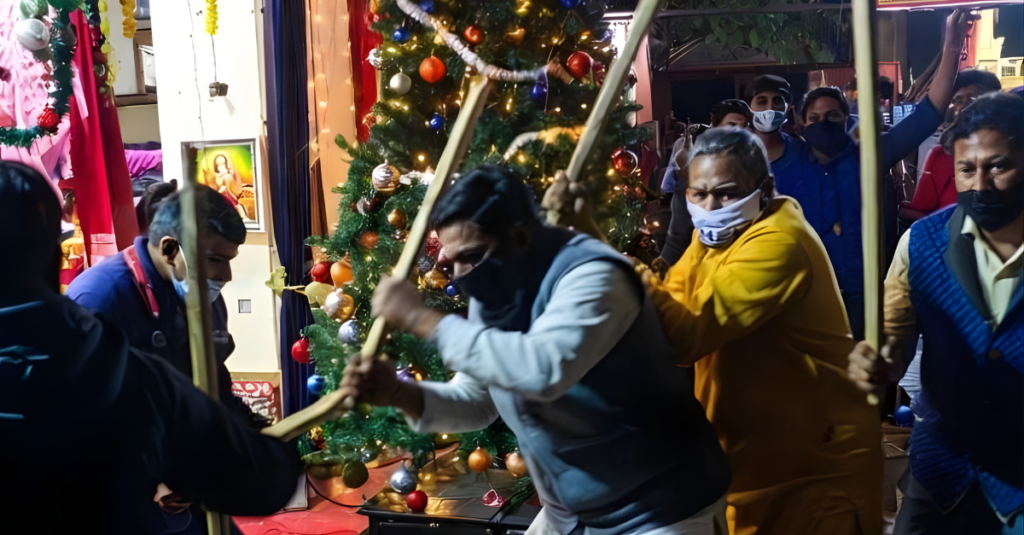
The destruction of Christmas symbols was widespread. In Raipur, Chhattisgarh, a mob of 40-50 men armed with rods and hockey sticks stormed the Magneto Mall on Christmas Eve, interrogating people about their faith while vandalizing Christmas trees and decorations.
Furthermore, in Puri, Odisha, street vendors selling Santa Claus costumes were harassed by right-wing activists who claimed items related to Christian festivals should not be sold in a “Hindu nation”. Even individuals wearing Christmas apparel in public spaces faced threats and intimidation.
Disruption of school and community events
Schools became prime targets for anti-Christmas actions. In Nalbari, Assam, VHP and Bajrang Dal members entered St. Mary’s School on Christmas Eve, burning student decorations while chanting “Jai Hindu Rashtra” (Hail Hindu Nation). Four district-level leaders were subsequently arrested.
Moreover, several schools across Kerala canceled Christmas programs following pressure from RSS groups, with some even returning money already collected from students for festivities. In Hisar, Haryana, Hindu groups conducted a Hanuman Chalisa recitation directly opposite the 160-year-old St. Thomas Church on Christmas Day, disrupting services and requiring heavy police presence.
Consequently, what should have been a time of peaceful celebration instead became a period marked by fear, as stated by C. Fernandas Rathina Raja, General Secretary of the Church of South India: “Are Christians slowly being pushed into a situation where they can no longer feel safe or free to practice their faith?”
Voices from the Church: Reactions and Condemnations
In response to the Christmas attacks, major Christian denominations across India issued unprecedented statements condemning the violence and calling for governmental action.
Statement from the Church of South India
On December 25, 2025, the Church of South India (CSI) published a forceful statement condemning the “series of incidents” involving intimidation and disruption of Christmas celebrations. General Secretary C. Fernandas Rathina Raja noted with alarm: “Until now, we have never witnessed so many incidents, especially on Christmas Day”. His statement raised a pivotal question: “Are Christians slowly being pushed into a situation where they can no longer feel safe or free to practice their faith?”.
In January 2026, the CSI Diocese of Madras organized a “Condemnation Protest Demonstration” that united Anglican, Catholic, Evangelical, Pentecostal, and Lutheran representatives in a rare show of ecumenical solidarity.
Catholic Bishops’ Conference of India response
The Catholic Bishops’ Conference of India (CBCI) preceded the CSI with a December 23 statement expressing “deep anguish” over the “alarming rise in attacks on Christians”. The bishops were “particularly shocked” by a video from Jabalpur showing a visually impaired woman being publicly abused during a Christmas program.
The CBCI also condemned “hate-filled digital posters in Chhattisgarh allegedly calling for a bandh on 24 December 2025 against Christians,” warning these could “inflame tensions and incite further violence”.
Appeals to government and civil society
Beyond condemnation, church leaders made direct appeals to authorities. In late December, over 400 Christian leaders and 30 church groups sent an urgent letter to President Murmu and Prime Minister Modi. The letter cited verified data showing 640 attacks in 2024—nearly quadruple the 147 incidents recorded in 2014.
The United Christian Forum specifically appealed to Home Minister Amit Shah to cancel the Chhattisgarh Bandh planned against Christians. Church leaders called for swift investigations into attacks, clear guidelines to states on protecting constitutional rights, regular dialog with faith communities, and addressing systemic issues like the misuse of anti-conversion laws that led to the arrest of over 110 clergy members.
“This appeal is born out of the deep pain we have witnessed,” explained Vijayesh Lal, Secretary General of the Evangelical Fellowship of India.
The Bigger Picture: Trends in Christian Persecution
The persecution of Christians in India has reached unprecedented levels, with data revealing a dramatic 500% increase in violence against the community since 2014. This alarming upward trajectory tells a story far beyond the Christmas 2025 incidents.
Rise in attacks since 2014
Documented anti-Christian incidents jumped from 139 cases in 2014 to an alarming 834 cases in 2024, representing a 555% increase over the decade. This pattern has continued relentlessly, with organizations recording 579 separate incidents in just the first nine months of 2025. Indeed, Christophe Jaffrelot asserts that Indian Christians have now become “prime targets” of Hindu nationalist attacks since the BJP came to power in 2014.
Regions most affected
Five states account for over three-quarters of all documented cases in the past decade. Uttar Pradesh leads with 1,317 recorded incidents, followed by Chhattisgarh (926), Tamil Nadu (322), Karnataka (321), and Madhya Pradesh (319). Notably, Christians have been denied access to water from community sources in Chhattisgarh, and even denied burial rights.
Role of right-wing groups like RSS and VHP
The main sources of Christian persecution include the Sangh Parivar, a consortium of Hindu extremist organizations. Essentially, groups like VHP, Bajrang Dal, and RSS have orchestrated efforts to exploit sectarian violence to raise their political power base. Throughout India, these organizations promote the argument that India should be a Hindu state.
Faith vs. Fear: Legal Rights and Ground Realities
“Attacks (on Christians) are not isolated law-and-order issues. They strike at the heart of our Constitution — at the freedom of conscience, the right to profess and practice religion, and the right to worship without fear.” — Dolphy D’Souza, Spokesperson, Bombay Catholic Sabha, advocate for religious freedom
The gap between constitutional promises and lived experiences for Christians in India reveals how legal protections often exist only on paper.
What Article 25 of the Constitution guarantees
Article 25 of India’s Constitution explicitly guarantees that “all persons are equally entitled to freedom of conscience and the right freely to profess, practice and propagate religion”. Nevertheless, this right remains “subject to public order, morality and health”. The term “propagate” was deliberately included to guarantee Christians the right to convert others. In theory, these provisions create a secular framework protecting religious minorities.
How enforcement fails on the ground
In practice, state-level anti-conversion laws directly conflict with Article 25. Although these laws supposedly protect against “inappropriate” conversions, they fail to clearly define what makes a conversion inappropriate. Certainly, law enforcement often aids mobs disrupting Christian worship services. The United Christian Forum reported that in 80% of cases, police refused to file required First Information Reports. Furthermore, India’s criminal justice system disproportionately detains religious minorities, with Muslims and Sikhs overrepresented among pre-trial detainees.
Impact on freedom of religion and expression
These realities force Christians to self-censor. In Uttarakhand, numerous pastors deleted their social media content, YouTube sermons, and some even prepared to leave the state altogether. Ironically, while conversion to Christianity faces severe penalties, “reconversion” to Hinduism (called “ghar wapsi” or “homecoming”) faces no legal scrutiny. This double standard effectively undermines constitutional freedoms, creating an atmosphere where religious minorities must practice their faith in constant fear.
Conclusion
The reality for Christians in India stands in stark contrast to constitutional promises. Christians face daily threats, with attacks increasing by 555% since 2014, reaching an alarming 834 incidents in 2024 alone. Christmas 2025 particularly showcased this persecution through targeted violence against carolers, church congregations, and even children.
Religious freedom guarantees under Article 25 have become meaningless for many believers who now practice their faith under constant fear. Far from isolated incidents, these attacks represent systematic intimidation orchestrated primarily by right-wing groups with apparent impunity. Meanwhile, law enforcement officials often refuse to file reports or, worse still, participate in the harassment themselves.
Church leaders across denominations have united in unprecedented ways, though their pleas for protection remain largely unaddressed. States like Uttar Pradesh and Chhattisgarh have become particularly dangerous for Christians, who face discrimination ranging from denial of basic services to violent mob attacks.
We must recognize these events as more than religious conflicts. They represent fundamental challenges to India’s identity as a secular democracy. Until government authorities enforce constitutional protections equally for all citizens, Christians will continue living as second-class citizens, practicing their faith behind closed doors, deleting sermons from social media, and wondering if next Christmas might bring violence instead of peace. The question posed by church leaders remains unanswered: Are Christians slowly being pushed into a situation where they can no longer feel safe or free to practice their faith?




1 Comment